
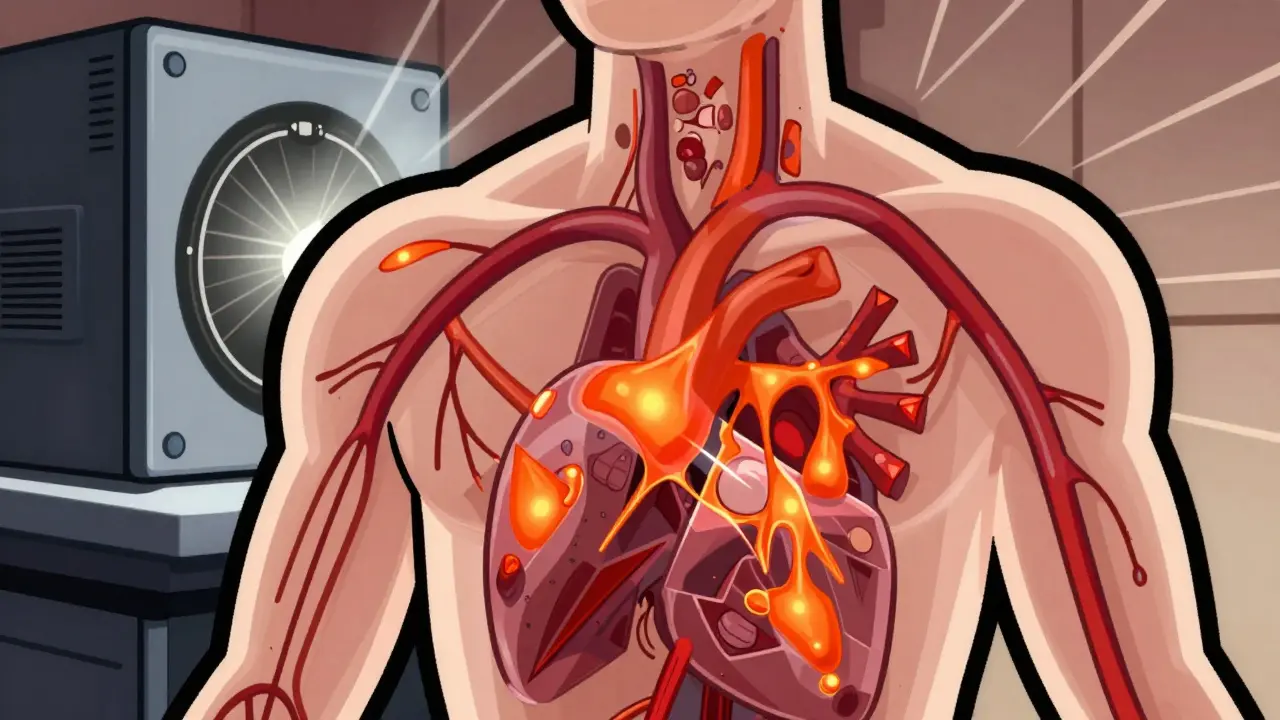
Most people don’t know their arteries are silently clogging up years before they feel any symptoms. A simple, 5-minute CT scan can show you exactly how much plaque is building up in your heart’s arteries-and whether you’re at real risk for a heart attack. This isn’t science fiction. It’s called a coronary calcium score, and it’s one of the most accurate tools doctors have to catch heart disease before it’s too late.
What Exactly Is a Coronary Calcium Score?
A coronary calcium score comes from a special type of CT scan that looks for calcium deposits in the arteries that feed your heart. These deposits aren’t just random spots-they’re hardened pieces of plaque, the same gunk that can block blood flow and trigger a heart attack. The scan doesn’t need dye, needles, or stress tests. You lie on a table, hold your breath for 10 to 15 seconds, and the machine takes pictures. That’s it.
The result? A number. Zero means no detectable calcium. Anything above zero? That’s plaque. And even a small amount-like a score of 15-means you already have early coronary artery disease. It’s not a guess. It’s a direct measurement. The higher the number, the more plaque you have. A score over 400? That’s a red flag. People with scores that high are five times more likely to have a heart attack in the next 10 years than someone with a score of zero.
How the Score Is Calculated: The Agatston Method
The number you get isn’t random. It’s calculated using something called the Agatston Score, developed by radiologist Dr. Arthur Agatston in the 1990s. The CT machine doesn’t just count calcium spots-it measures how dense they are. Each spot gets a score between 1 and 4 based on how bright it looks on the scan. Brighter = denser = more calcified = more dangerous. Then it multiplies that by the size of the spot. All those numbers add up to your final score.
But here’s the key: your score alone doesn’t tell the whole story. Doctors compare it to others your age, sex, and ethnicity using a percentile system. A score of 120 might be normal for a 65-year-old man but alarming for a 45-year-old woman. That’s why the MESA (Multi-Ethnic Study of Atherosclerosis) database is used-it gives context. Without it, you’re just looking at a number without meaning.
Who Should Get a Coronary Calcium Scan?
This test isn’t for everyone. It’s designed for people who are at intermediate risk-meaning they don’t have symptoms, but they’re not low-risk either. Think: someone with high cholesterol, a family history of early heart disease, high blood pressure, or who smokes but doesn’t have diabetes or a prior heart attack.
Traditional risk calculators, like the one used by most doctors, often get it wrong. Studies show they misclassify up to 30% of people. Someone might be told they’re “low risk” based on their age and cholesterol-but their calcium score shows 200. That’s a wake-up call. In fact, research from the Journal of the American College of Cardiology found that calcium scoring changes risk classification in 40 to 50% of intermediate-risk patients. That means a lot of people who were told to just “watch their diet” suddenly need statins or more aggressive treatment.
The American College of Cardiology and American Heart Association now recommend it for adults aged 40 to 75 with borderline or intermediate risk. It’s especially useful if you’re unsure whether to start a statin. A score above 100? That’s a strong signal to start one. A score over 300? High-intensity statin, no debate.
What the Numbers Really Mean
Let’s break down what your score actually tells you:
- 0: No detectable calcium. Very low risk of heart attack in the next 10 years.
- 1-10: Minimal plaque. Still low risk, but not zero. Watch your habits.
- 11-100: Mild plaque. You have early heart disease. Lifestyle changes are critical.
- 101-400: Moderate plaque. Your risk of a heart event is 75% higher than average. Statins are usually recommended.
- 401+: Extensive plaque. High risk. You’re in the top 10% of risk for your age group. Aggressive treatment is needed.
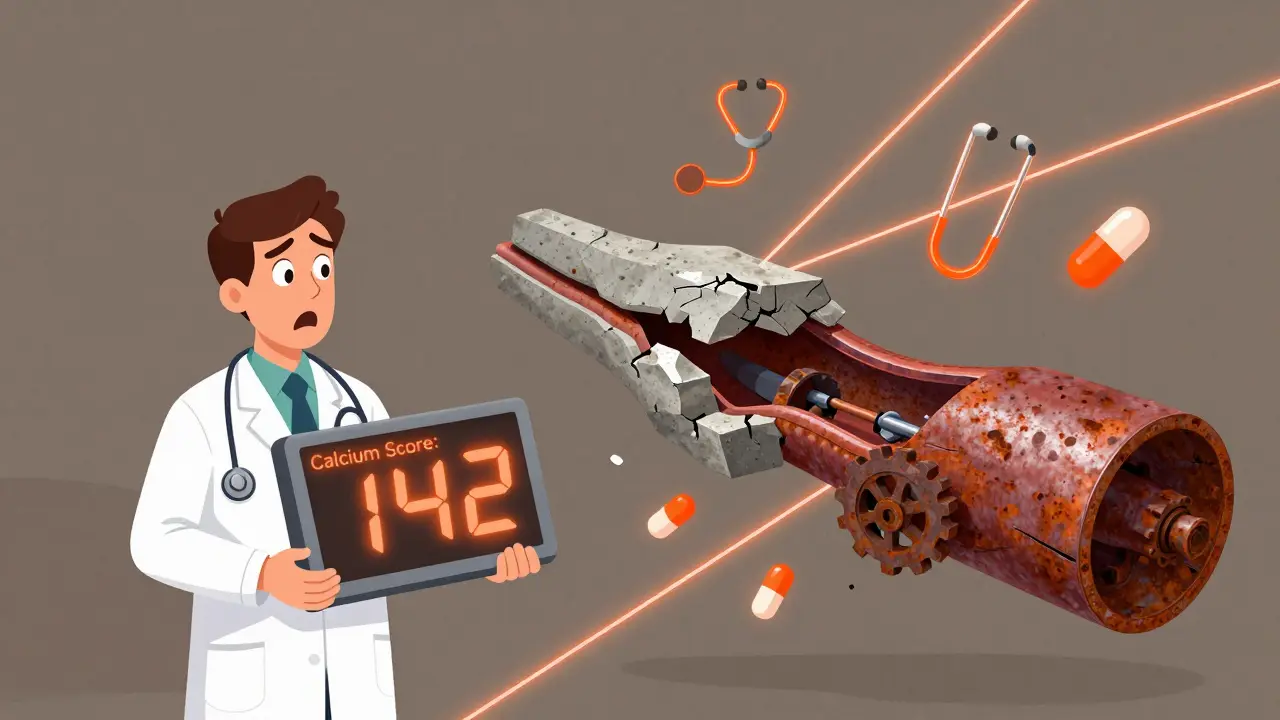
One man in his early 50s from Sydney got a score of 142. His doctor had suggested statins for years, but he kept putting it off. After seeing the scan, he quit smoking, started walking daily, and began taking a statin. “It wasn’t the cholesterol numbers,” he told me. “It was seeing the actual gunk in my arteries. That made it real.”
Limitations: What the Scan Can’t Tell You
It’s not perfect. The scan only sees calcium. About 20-30% of plaque is soft and doesn’t show up. That’s why someone with a low score could still have dangerous blockages. For that, you’d need a coronary CT angiogram (CCTA), which uses contrast dye and gives more detail-but it’s more expensive and exposes you to more radiation.
Also, people with chronic kidney disease often have calcium deposits from their disease, not from heart plaque. That can make their score look worse than it is. And while the radiation dose is low-about the same as a mammogram-it’s still radiation. That’s why it’s not recommended for people under 40 or those with no risk factors.
How It Compares to Other Tests
Stress tests? They’re indirect. They look for signs your heart is struggling under pressure, but they miss early disease. They also have a 15-20% false positive rate, meaning you might get told you have a problem when you don’t.
Blood tests? Cholesterol levels alone don’t show where the plaque is. Two people can have the same LDL and one has a score of 5, the other 800. The blood test can’t tell you which is which.
Coronary calcium scoring gives you a direct picture. It’s like seeing the roadblock before you crash into it. That’s why cardiologists are calling it the missing link in prevention.
Insurance, Cost, and Access
Here’s the catch: insurance doesn’t always cover it. Medicare doesn’t pay for it yet. In Australia, it’s often out-of-pocket-between $150 and $300 depending on the clinic. In the U.S., 41% of commercially insured patients still pay something. That’s a barrier for many.
But the cost of ignoring it? Much higher. A heart attack can cost over $100,000 in treatment. Preventive care, even if you pay upfront, saves money and lives.
Most major hospitals and imaging centers in Sydney, Melbourne, and Brisbane now offer the test. You usually need a referral from your GP or cardiologist. The scan itself takes less than five minutes. Results come back in a couple of days.
What Happens After the Scan?
Your score doesn’t just sit on a report. It changes your plan.
- If your score is low (under 10), focus on diet, exercise, and not smoking.
- If it’s between 11 and 100, add a daily aspirin (if your doctor says so) and consider a statin.
- If it’s above 100, you’re likely on a statin already. You’ll need tighter control of blood pressure and cholesterol.
- If it’s above 400, your doctor will likely refer you for further testing and may recommend more aggressive therapy.
One study found that people who saw their calcium score were 3 times more likely to stick with lifestyle changes than those who only got blood test results. Seeing is believing. And in heart health, that can mean the difference between living well and facing a crisis.
The Future of Calcium Scoring
AI is making the scans faster and safer. New algorithms cut radiation by 40% without losing accuracy. The NIH is running a major study tracking 10,000 people to set clearer treatment rules based on scores. And more insurers are starting to cover it-especially for high-risk groups.
By 2028, experts predict over 3 million scans will be done in the U.S. alone. Australia is catching up. The European Society of Cardiology now says it should be a first-line test for people with a family history of early heart disease.
This isn’t a luxury. It’s a tool for prevention. And prevention is the only way to stop heart disease before it starts.
Is a coronary calcium scan the same as a stress test?
No. A stress test checks how your heart performs under physical strain, often using a treadmill or drugs to raise your heart rate. It looks for signs of reduced blood flow. A coronary calcium scan uses CT imaging to directly visualize calcium deposits in your arteries. It doesn’t require exercise or stress-it’s a snapshot of existing plaque, not how your heart responds to demand.
Can a calcium score be wrong?
It’s very accurate at detecting calcified plaque-over 95% sensitive. But it can’t see soft, non-calcified plaque, which makes up about a quarter of all plaque. So a low score doesn’t guarantee you’re free of blockages. Also, conditions like kidney disease can cause false high scores due to vascular calcification unrelated to heart disease. That’s why results are always interpreted alongside your overall health.
Do I need to fast before the scan?
You don’t need to fast, but you should avoid caffeine and smoking for at least 4 hours before the test. Caffeine can raise your heart rate, which can blur the images. No fasting, no IV, no contrast dye. Just show up, lie down, hold your breath, and it’s over in minutes.
How often should I get a coronary calcium scan?
If your score is zero and you have no risk factors, you might not need another for 5-10 years. If your score is high, your doctor may repeat it in 2-3 years to track progress. For people on treatment, the scan helps measure whether lifestyle changes or medications are working. It’s not meant to be done yearly unless your doctor recommends it.
Is the radiation from the scan dangerous?
The radiation dose is low-about 1 to 3 millisieverts, similar to a mammogram or a round-trip flight from Sydney to Melbourne. For someone with moderate to high heart disease risk, the benefit of knowing their true risk far outweighs the tiny radiation exposure. But it’s not recommended for young, low-risk people without symptoms.
Can a calcium score predict stroke risk too?
Not directly. The scan measures plaque in the heart’s arteries. Stroke risk is more linked to carotid arteries in the neck and other factors like atrial fibrillation. But if you have significant coronary plaque, it often means you have widespread atherosclerosis-which increases your overall cardiovascular risk, including stroke. So while it’s not a stroke test, it’s a sign you need to manage your overall vascular health.



13 Comments
This is so eye-opening 😍 I got my score last year-turned out to be 87. My doctor said I was ‘low risk’ based on cholesterol, but this scan? Total wake-up call. I started walking 6K steps a day and swapped my morning donut for avocado toast. No regrets. 🥑❤️
Let me guess-Big Pharma paid the radiologists to push this. 😏 You think they’d let you see your arteries if it didn’t mean you’d need a $1200 statin? The ‘calcium score’ is just a fancy way to scare people into lifelong drug dependence. Meanwhile, the real cause? Sugar. Processed food. The system wants you sick. 🤔
OMG YES. I’m 48, had zero symptoms, and my doc said I was fine. Then I got the scan-score of 156. I cried. Not from fear-from relief. I finally had proof I needed to change. Now I’m plant-based, meditate daily, and my BP is normal. This test saved my life. If you’re over 40 and even a little worried? DO IT. No excuses.
Okay but… isn’t this just another way to monetize fear? You get a number, panic, then buy a million supplements, a Peloton, and a $500 ‘heart-healthy’ meal plan. Meanwhile, your cortisol is through the roof because you’re now obsessed with your ‘score.’ I’ll stick with my kale and ignorance, thanks.
I had this done after my dad had a heart attack at 52. Score was 210-scary, but also a gift. I started taking a low-dose statin and walking every lunch break. My wife says I’ve become a walking wellness brochure, but honestly? Worth it. I don’t want to miss my kids’ graduations.
It is imperative to note that while the coronary calcium score provides valuable anatomical insight, it does not constitute a comprehensive assessment of cardiovascular risk. One must consider biomarkers, genetic predisposition, and lifestyle variables in tandem. The overreliance on imaging metrics may lead to diagnostic oversimplification. Please consult with a qualified physician before initiating any therapeutic regimen.
My wife got her score last month-zero. She’s 42, eats clean, runs marathons. But her mom had a heart attack at 45. She was so relieved. Then I got mine-312. I was in denial until I saw the scan. Saw actual white spots in my arteries. I quit soda, started walking, and now I’m on a statin. Honestly? I wish I’d done this five years ago. Don’t wait until you’re in the ER.
So… this is just a glorified X-ray with a price tag? And now we’re supposed to panic because some algorithm says ‘moderate plaque’? Bro, I’ve got a 400 score and I still drink beer and eat bacon. My grandpa lived to 92 on a diet of pork rinds and whiskey. Maybe the whole ‘heart disease = plaque’ thing is a lie. 🤷♂️
Why are you listening to doctors? Eat garlic. Drink lemon water. Pray. Your arteries will clean themselves. This scan is a scam. I am from India, where people live to 100 without CT scans.
Just got mine-score of 42. Felt weird seeing it. Not scary, just… real. Like looking at your credit score but for your heart. I’ve been meaning to quit smoking. Maybe this is the sign. I’m doing it next week. Fingers crossed.
While the Agatston methodology is statistically robust, the clinical utility of coronary calcium scoring remains contentious within peer-reviewed literature. The 2019 ACC/AHA guidelines explicitly caution against its use in low-risk populations due to potential for overdiagnosis and unnecessary intervention. The assertion that a score above 100 mandates statin therapy lacks sufficient longitudinal evidence.
My sister got a score of 480 at 51. She had zero symptoms. Now she’s on high-intensity statins, eats like a monk, and walks 10K steps daily. She says it’s the best thing she ever did. I’m getting mine next month. Seeing is believing. 💕
I’m not convinced. I’ve seen too many people get these scores and then get pushed into treatments they don’t need. The system profits from fear. I’d rather trust my body than a machine that sees calcium and calls it doom.