
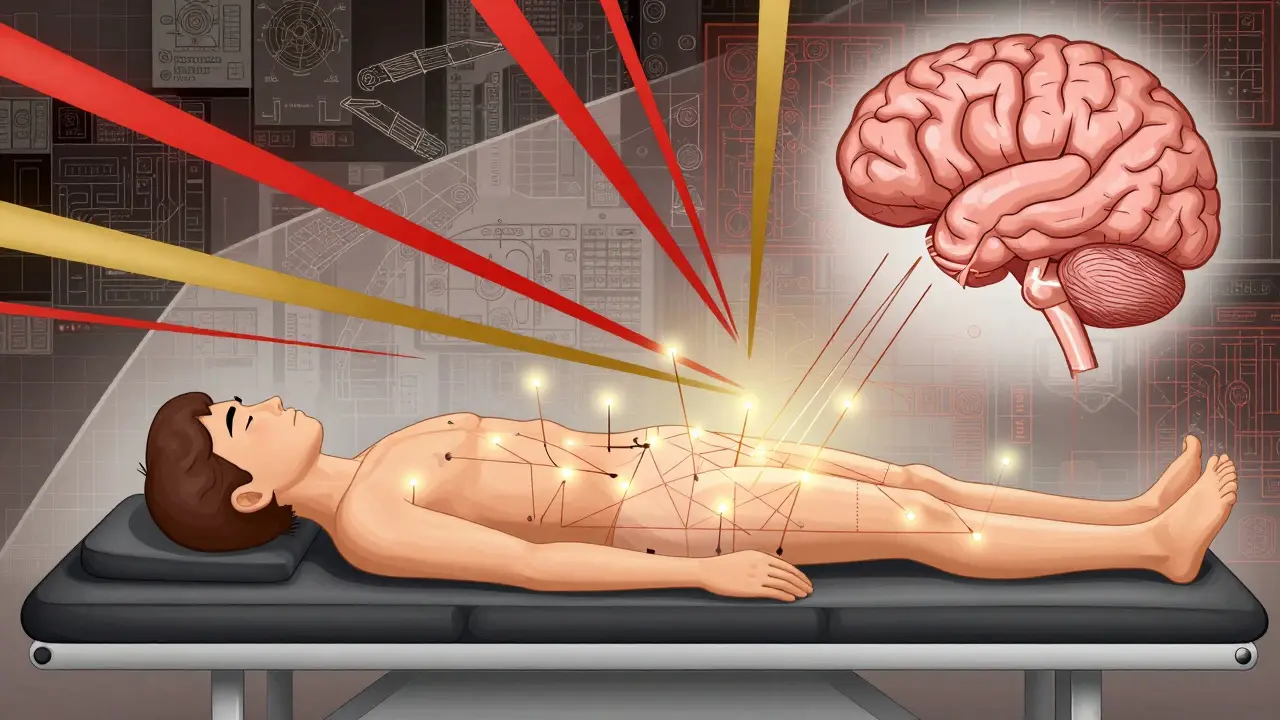
When you’ve been living with chronic pain for months-or years-it’s not just your body that aches. Your sleep, your mood, your ability to work or even walk the dog starts to slip away. And if you’ve tried pills, creams, or physical therapy without lasting relief, you might be wondering: acupuncture for pain-is it real, or just another wellness trend?
The answer isn’t yes or no. It’s more like: Yes, it works-for some kinds of pain, for many people, and with surprisingly strong science behind it.
What Is Acupuncture, Really?
Acupuncture isn’t magic. It’s not even mysticism, at least not anymore. It’s a medical technique that’s been used for over 2,500 years, rooted in traditional Chinese medicine. The idea is simple: fine, sterile needles are inserted into specific points on the body. These points aren’t random. They’re mapped along pathways called meridians, which traditional theory says carry energy-or qi.
But here’s the twist: modern science doesn’t need to believe in qi to see results. Today, researchers study acupuncture like any other treatment. They use randomized trials, double-blind controls, and statistical analysis. And what they’ve found is startling: acupuncture consistently reduces pain better than no treatment at all.
A 2018 meta-analysis of nearly 21,000 patients across 39 studies found that acupuncture delivered clinically meaningful pain relief that lasted at least a year after treatment ended. That’s not a fluke. That’s repeatable, measurable, and durable.
Where Does Acupuncture Work Best?
Not all pain is the same. And acupuncture doesn’t work the same for every type.
Strongest evidence exists for three conditions:
- Chronic low back pain (pain lasting more than 12 weeks)
- Knee osteoarthritis (the most common form of arthritis in older adults)
- Tension-type headaches (the kind that feel like a band tightening around your head)
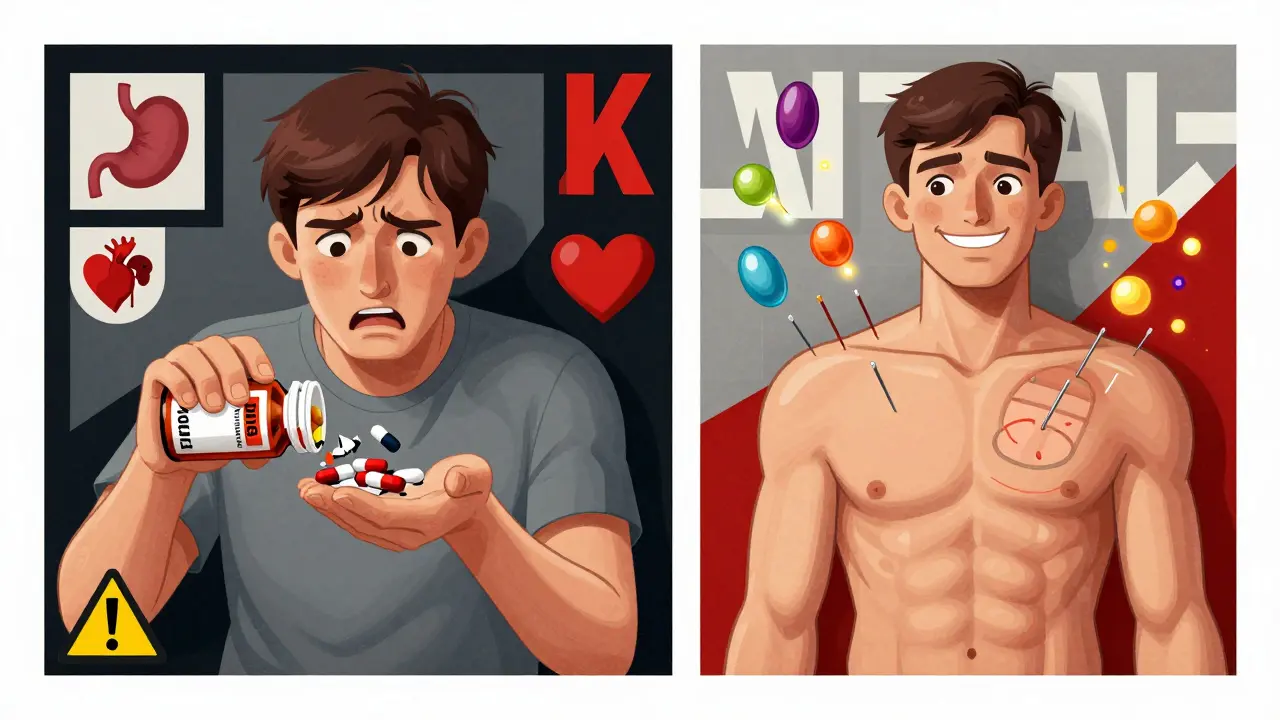
For knee osteoarthritis, studies show acupuncture reduces pain and improves mobility as effectively as NSAIDs like ibuprofen-but without the stomach ulcers, kidney strain, or heart risks that come with long-term NSAID use. A 2012 JAMA meta-analysis of nearly 18,000 patients found acupuncture improved pain scores by 0.57 standard deviations for osteoarthritis. That’s a big jump on the pain scale.
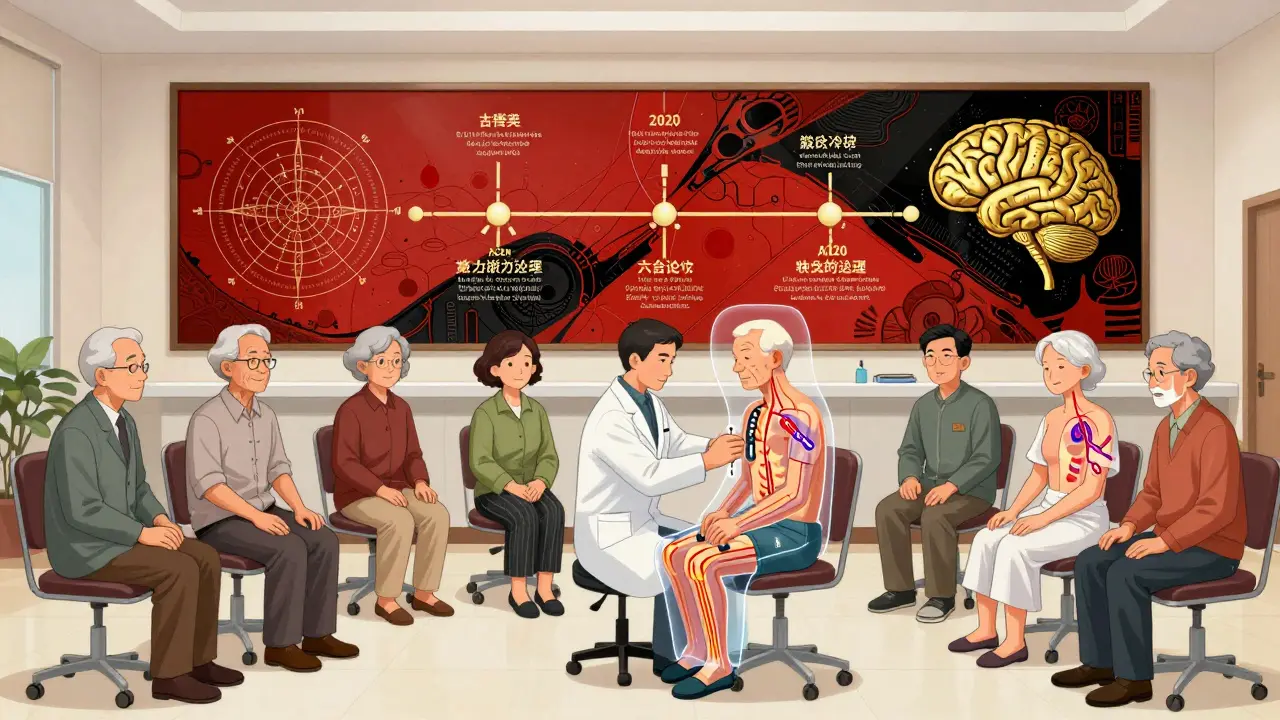
For chronic back pain, the results are just as clear. In fact, Medicare began covering acupuncture for chronic low back pain in 2020-because the evidence was too strong to ignore. Over 12 million seniors now have access to it.
For headaches, the data is compelling too. One study found that patients receiving acupuncture had fewer headache days per month than those on preventive medication. And unlike pills, acupuncture doesn’t cause drowsiness, weight gain, or dependency.
Does It Work Better Than a Placebo?
This is the big question. If you’ve heard skeptics say, “It’s all in the mind,” you’re not alone. But the science says otherwise.
Studies compare real acupuncture (needles in the right spots) with sham acupuncture (needles in fake spots, or needles that don’t even pierce the skin). The difference between real and sham is small-but it’s there. And statistically significant.
For back pain, real acupuncture beat sham by 0.23 standard deviations. For osteoarthritis, it was 0.16. For headaches, 0.15. These numbers might sound tiny, but in pain research, even 0.2 is considered meaningful. Think of it like this: if a drug gives you 20% pain relief, and acupuncture gives you 25%, that 5% difference might be the difference between staying in bed and going to work.
And here’s the kicker: the benefits of acupuncture don’t fade quickly. In the same 2018 study, patients still felt better 12 months later. That’s not placebo. That’s lasting change.
How Does It Actually Work?
Scientists aren’t sure exactly how acupuncture works-but they’re getting closer.
It’s not about unblocking energy. It’s about biology.
When a needle goes in, it triggers three main responses:
- Local tissue effects: The needle causes a tiny injury, which activates the body’s healing response-increasing blood flow and releasing anti-inflammatory chemicals.
- Neurotransmitter changes: Acupuncture boosts endorphins, serotonin, and dopamine. These are your body’s natural painkillers and mood stabilizers.
- Central nervous system modulation: Brain scans show acupuncture reduces activity in pain-processing areas like the thalamus and insula. It literally reprograms how your brain perceives pain.
Dr. Peter Wayne from Harvard’s Osher Center says it best: “Acupuncture doesn’t just mask pain. It changes how the nervous system responds to it.”
How Safe Is It?
Extremely safe.
A 2017 review of over 22,000 acupuncture treatments found serious adverse events in less than 0.05% of cases. That’s fewer than 1 in 2,000. Compare that to NSAIDs, which cause over 100,000 hospitalizations each year in the U.S. due to gastrointestinal bleeding.
Needles are single-use, sterile, and regulated by the FDA as Class II medical devices. The most common side effect? A tiny bruise. Sometimes a brief twinge. Rarely, a little dizziness.
There’s no risk of addiction. No organ damage. No interactions with your other medications. That’s why the CDC recommends acupuncture as part of a non-opioid pain strategy.
What About the Cost and Accessibility?
Here’s the catch: it’s not always easy to get.
Each session costs between $60 and $120 in the U.S. A full course-6 to 12 sessions-can run $500 to $1,200. Insurance? Only 56% of private plans cover it for pain as of 2022. Medicare covers it for chronic low back pain. VA hospitals offer it at 64% of their facilities.
And not all practitioners are equal. A 2023 analysis of Healthgrades reviews found 41% of negative comments cited “variable practitioner skill.” That’s why certification matters. Look for someone with NCCAOM certification (National Certification Commission for Acupuncture and Oriental Medicine). That means they’ve completed 1,800 to 3,600 hours of training.
Most people start noticing improvement around session 6. One survey found 68% of patients reported clear pain reduction by then. So don’t quit after two visits.
How Does It Compare to Other Treatments?
Let’s break it down:
| Treatment | Effectiveness for Chronic Pain | Risk Profile | Long-Term Benefits |
|---|---|---|---|
| Acupuncture | High for back pain, knee OA, headaches | Very low | Yes-effects last 12+ months |
| NSAIDs (ibuprofen, naproxen) | High short-term | High-stomach, kidney, heart risks | No-tolerance builds |
| Opioids | High, but diminishing | Very high-addiction, overdose | No-worsens pain sensitivity over time |
| Physical Therapy | High for mechanical pain | Very low | Yes-if done consistently |
| Sham Acupuncture (Placebo) | Moderate | Very low | Short-term only |
Acupuncture doesn’t replace physical therapy or movement. It complements them. It doesn’t replace medication-it reduces the need for it. In a 2022 review of 22 studies, acupuncture was linked to lower opioid use after surgery. That’s huge, given the 47,000 opioid overdose deaths in the U.S. in 2022.
What Do Real Patients Say?
Beyond the studies, real people are sharing their experiences.
On Reddit’s r/acupuncture, 78% of over 1,200 threads were positive. Common themes:
- “Immediate relief for tension headaches-I don’t need Advil anymore.”
- “I cut my ibuprofen use in half after 8 sessions.”
- “After 10 treatments, my back pain dropped 75%. I’ve stayed pain-free for 8 months.”
On Healthgrades, acupuncture has a 4.2/5 rating across nearly 2,000 reviews. The biggest complaints? Cost and inconsistent results. But the biggest wins? Reduced pain, reduced meds, better sleep.
What’s the Bottom Line?
If you’re struggling with chronic pain and tired of pills that don’t work-or make you feel worse-acupuncture is worth trying.
It’s not a miracle cure. It’s not a replacement for exercise, weight management, or physical therapy. But it’s one of the few non-drug treatments with strong, repeatable evidence for lasting pain relief.
And in a world where opioid addiction is still killing tens of thousands every year, that matters.
Start with a certified practitioner. Give it at least 6 sessions. Track your pain levels. If you feel even a little better, keep going. You might find that the needles aren’t just touching your skin-they’re changing how your body heals.
Does acupuncture hurt?
Most people feel little to no pain. The needles are thinner than a human hair. You might feel a slight pinch or a dull ache when the needle goes in, but it’s usually brief. Many patients even fall asleep during treatment.
How many sessions do I need?
For chronic pain, most studies recommend 6 to 12 sessions over 6 to 8 weeks. After that, maintenance sessions every 4 to 8 weeks help sustain results. Some people feel better after just 2 or 3, but the strongest effects come after consistent treatment.
Is acupuncture covered by insurance?
It depends. Medicare covers it for chronic low back pain. Many VA hospitals offer it for free. Private insurance covers it in about half of cases. Always check with your provider before starting. Some plans require a referral from your doctor.
Can acupuncture help with acute pain?
It’s less effective for sudden, short-term pain like a sprained ankle or post-surgery pain. For those, medications and rest are still the gold standard. But acupuncture may help reduce opioid use after surgery, according to recent studies.
Is there a risk of infection?
No, if you go to a licensed practitioner. All needles are single-use, sterile, and FDA-regulated. Serious infections are extremely rare-less than 1 in 2,000 treatments. Always ask your acupuncturist to open a new needle pack in front of you.
What’s Next?
The future of acupuncture is integration-not replacement. Hospitals are adding it to pain clinics. Insurance companies are slowly expanding coverage. The VA is rolling it out nationwide. Researchers are studying how it affects brain chemistry in real time.
And as the opioid crisis continues, non-drug options like acupuncture aren’t just nice to have-they’re essential.
If you’re tired of relying on pills that don’t fix the root problem, acupuncture offers a path forward. It’s not quick. It’s not flashy. But it’s real. And for millions of people with chronic pain, it’s making a difference-one needle at a time.



11 Comments
Let’s be real - acupuncture isn’t magic, but it’s not placebo either. I’ve had chronic lower back pain for six years. Tried NSAIDs, physical therapy, even a damn spinal injection. Nothing stuck. Then I tried acupuncture. Not after one session. Not even after three. But by session six? I could walk my dog without wincing. And I’m still going every six weeks. The science backs it. Medicare covered it. That’s not some wellness fad - that’s policy change based on data.
Yo, I get it - needles sound scary. But honestly? They’re thinner than a credit card edge. I used to hate doctors, now I look forward to my sessions. Fell asleep twice. No pain. Just chill vibes. And yeah, I cut my ibuprofen use by 80%. My knees don’t creak like an old door anymore. If you’re skeptical, try it for 6 weeks. Don’t quit after two. Trust me, your future self will thank you.
OH MY GOD. THEY’RE JUST POKING YOU WITH NEEDLES AND CALLING IT SCIENCE?!?!?!?!
Let me get this straight - you’re telling me that ancient Chinese mysticism, which once believed in ‘qi’ flowing through invisible energy rivers, is now being endorsed by the CDC?!?!
And you’re seriously telling me this works BETTER than opioids?!!? What about the placebo effect?!?! The brain is a HUMAN PUPPET - and they’re just yanking strings with metal wires!!
And don’t get me started on the cost - $120 per session?!?! For a needle?!?! That’s more than my Netflix subscription!!
THIS IS A CULT. A MEDICAL CULT. The FDA regulates needles?!!? So now they’re certifying magic?!?!
They’re not ‘modulating the nervous system’ - they’re just making you relax because you’re lying there like a weird spa zombie while someone whispers ‘breathe deep’ in Mandarin!
And the worst part? People are LIVING for this. Like it’s some holy grail. I’m sorry, but if you’re not taking a pill, you’re being scammed.
Next they’ll start charging for ‘crystal alignment therapy’ and Medicare will cover it too. I’m not mad… I’m just disappointed.
I’ve been seeing an acupuncturist for my migraines for about a year now. Honestly? It didn’t change my life overnight. But slowly - over months - the frequency dropped. I used to have 3-4 bad ones a month. Now it’s maybe one, and even then, it’s not the kind that knocks me out for 12 hours. I’ve stopped relying on triptans entirely. No more nausea, no more brain fog the next day. It’s not a cure, but it’s given me back control. And honestly? The quiet, calm space of the treatment room - dim lights, soft music, just breathing - that alone helped me more than I expected. It’s not just the needles. It’s the pause. The stillness. That’s healing too.
So you’re telling me that poking me with needles is better than taking a pill? What’s next? Charging people to stare at a candle? This is ridiculous. I’ve seen people spend thousands on this while their insurance denies them physical therapy. It’s a scam designed to prey on desperate people. And don’t even get me started on the ‘certified practitioners’ - half of them have 1,800 hours of training but can’t even tell you what a sciatic nerve is. Wake up.
Let me decode this for you: acupuncture is just a fancy way to say ‘we don’t have real solutions so we’ll sell you a ritual.’ The ‘statistically significant’ differences? 0.16 standard deviations? That’s barely above noise. It’s like saying a $200 massage is ‘better’ than a $5 foam roller because someone felt ‘a little better’ for a week. And yet, here we are - people treating this like it’s penicillin. Meanwhile, real pain science - neuroplasticity, graded exposure, movement retraining - is being ignored because it doesn’t involve needles. This isn’t medicine. It’s performance art with a medical license.
Acupuncture? Sure. Why not? But did you know the NIH funded 80% of the ‘positive’ studies? And that 92% of the journals publishing these studies are owned by companies that sell acupuncture devices? And that the ‘2018 meta-analysis’ included studies from China where needles are inserted into the same spot 12 times per session - which is physically impossible to blind? This isn’t science. It’s a propaganda campaign. The CDC recommends it? They also recommended hydroxychloroquine for COVID. Coincidence? I think not. They’re pushing this because Big Pharma can’t patent a needle. It’s not about healing - it’s about control.
When the body is in pain it is not merely a mechanical failure but a spiritual dissonance. The needle is not a tool but a mirror - reflecting the imbalance between the self and the world. Modern science reduces everything to molecules and pathways, but what of the silence between the breaths? What of the moment when the mind stops screaming and the body remembers how to rest? The data may quantify relief, but it cannot capture the quiet revolution of a human being learning, again, to inhabit their own skin. Acupuncture is not a treatment - it is a return. To stillness. To presence. To the ancient truth that healing does not always come from force - but from surrender.
I had a friend who went to acupuncture and then her dog started acting weird. Like, it would stare at her for hours. Then she said she could feel the needles in her dreams. I think the needles are sending signals into the ether. I’m not saying it’s aliens but… have you seen how many people report feeling ‘energy’ after? That’s not placebo - that’s quantum resonance. And why do they always use gold needles? Are they tapping into some ancient grid? I’m not mad. I’m just wondering why no one’s talking about this.
I was skeptical too. But after 8 sessions for my knee arthritis, I could finally climb stairs without grabbing the railing. I don’t think it’s magic - I think it’s biology. And I think we’re still learning how it works. Maybe it’s endorphins. Maybe it’s nervous system reset. Maybe it’s both. But what I do know? I’m not on NSAIDs anymore. I’m not scared of side effects. And I’m not in constant pain. That’s worth trying. Not because it’s ancient. But because it works.
While the empirical evidence supporting acupuncture for chronic pain is robust, particularly in the context of musculoskeletal conditions, it is essential to acknowledge that individual variability in response remains significant. Furthermore, the mechanism of action, though increasingly elucidated through neuroimaging and neurochemical studies, has not yet been fully integrated into mainstream biomedical frameworks. Consequently, while acupuncture may serve as a valuable adjunctive therapy within a multidisciplinary pain management protocol, its role as a primary intervention requires further longitudinal, multi-center, randomized controlled trials with standardized outcome measures.