

When a patient takes a pill that contains two or more drugs in one tablet-like a blood pressure medication combining an ACE inhibitor and a diuretic-they expect it to work exactly like the brand-name version. But proving that a generic version does the same thing isn’t as simple as comparing one drug to another. For combination products, bioequivalence testing is one of the most complex challenges in generic drug development today.
What Makes Combination Products Different?
Combination products aren’t just two pills in one. They’re fixed-dose combinations (FDCs), drug-device systems like inhalers or auto-injectors, or topical formulations like creams and foams that deliver multiple active ingredients. The problem? The ingredients don’t always behave the same way together as they do alone. One drug might change how the other is absorbed, broken down, or delivered to the target tissue. This means a generic version might have the same ingredients, but if the formulation isn’t identical in how it releases or distributes those drugs, it could be less effective-or even unsafe.The FDA, EMA, and WHO all require that generics prove bioequivalence: that they deliver the same amount of drug into the bloodstream at the same speed as the original. For single-drug products, that’s usually done with a simple study in 24-36 healthy volunteers. But for combination products? It’s a different story.
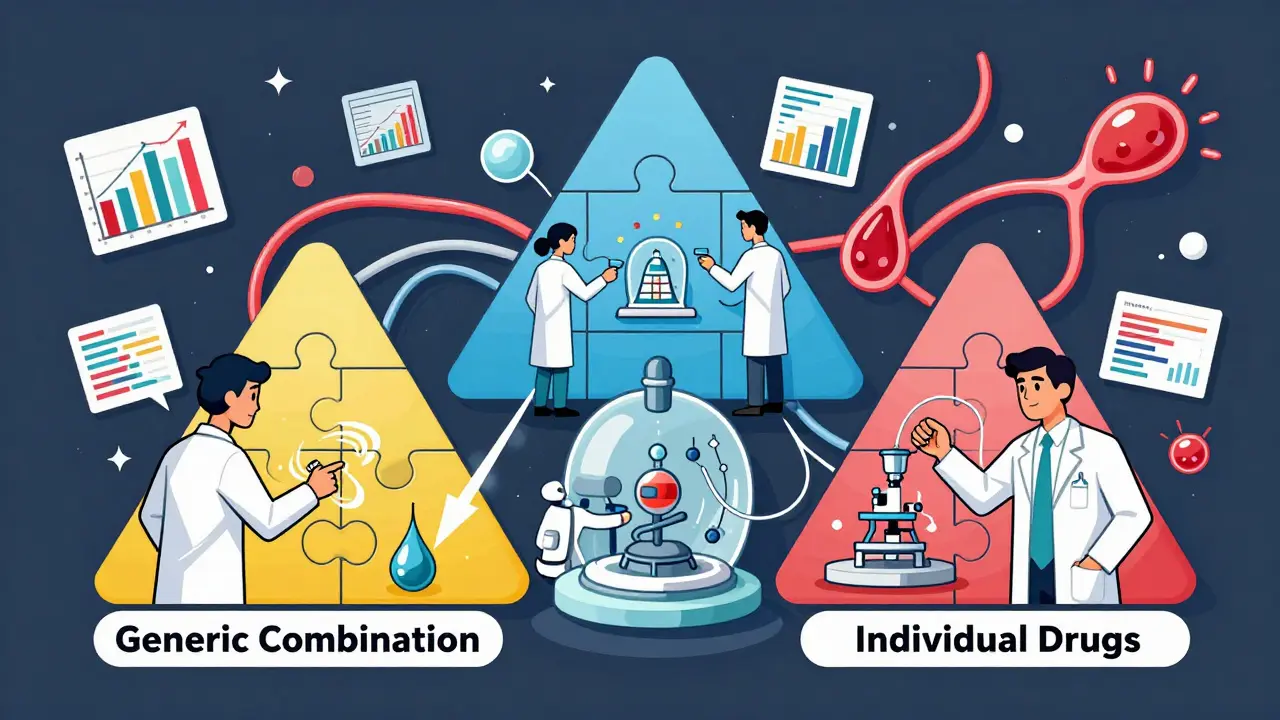
Testing FDCs: The Three-Way Crossover Problem
For fixed-dose combinations, regulators now require generic manufacturers to prove bioequivalence not just to the combination product itself, but also to each individual component taken separately. That means running a three-way crossover study: patients take the generic combination, the brand combination, and the two individual drugs given at the same time. This design increases the number of participants to 40-60 people and requires careful statistical handling to avoid false conclusions.And it’s not just about numbers. When one drug in the combination is poorly soluble-like some antifungals or antivirals-it can interact with the other, changing how quickly both are absorbed. A 2022 FDA analysis found that 35-40% of initial applications for modified-release FDCs failed bioequivalence testing on the first try. In one case, a generic version of a diabetes drug combining metformin and a DPP-4 inhibitor showed different absorption patterns because the tablet coating altered the release rate of one component. The company had to redesign the entire formulation.
Topical Products: Measuring What You Can’t See
Skin creams, ointments, and foams are even trickier. You can’t just measure drug levels in the blood-what matters is how much gets into the top layer of skin, the stratum corneum. The FDA recommends using tape-stripping: peeling off 15-20 thin layers of skin with adhesive tape and analyzing each for drug content. But here’s the catch: there’s no standard on how deep each strip should go or how much skin material to collect. One lab’s method might capture 80% of the drug; another’s might miss 30%.Because of this inconsistency, many developers turn to clinical endpoint studies-testing whether the generic reduces psoriasis symptoms just as well as the brand. But those studies need 200-300 patients per group and cost $5-10 million. That’s five times more than a standard bioequivalence study. Mylan (now Viatris) spent over two years trying to get a generic calcipotriene/betamethasone foam approved. Three consecutive bioequivalence studies failed because the tape-stripping data varied too much between labs. They eventually had to build their own validated method from scratch.
Drug-Device Combos: The User Interface Trap
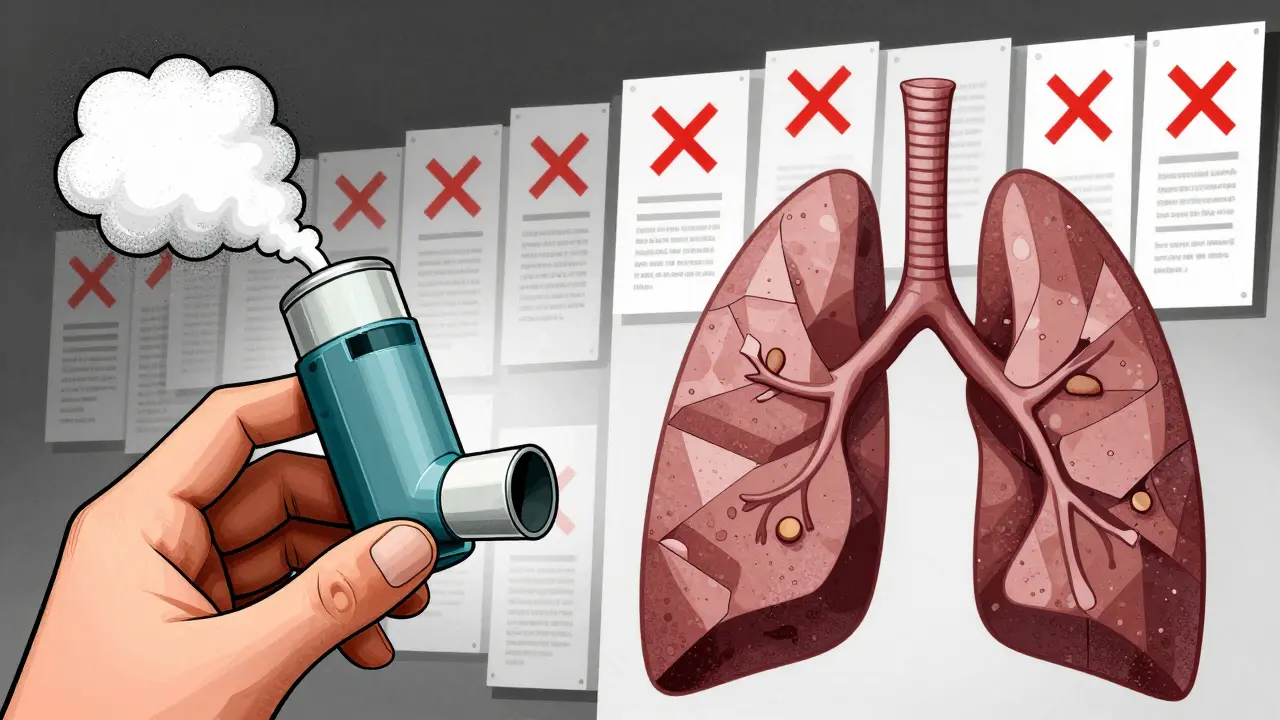
Inhalers, nasal sprays, and auto-injectors are another category entirely. Even if the drug formula is identical, a slight difference in how the device works can change everything. For inhalers, the particle size distribution must be within 80-120% of the reference product. A nozzle that’s 0.1 mm wider might deliver 15% less drug to the lungs. For auto-injectors, the force needed to activate the device, the speed of injection, or even the color of the cap can affect whether a patient uses it correctly.According to Dr. William Doub of the FDA, 65% of complete response letters for generic drug-device products cite problems with user interface testing. One generic inhaler failed because its mouthpiece was slightly more rigid than the brand, causing 12% of users to inhale too slowly-dropping lung delivery below acceptable levels. The company had to redesign the entire device, delaying approval by 18 months.
Why This Costs So Much-and Takes So Long
Developing a generic combination product isn’t just harder. It’s exponentially more expensive. A standard oral generic might cost $5-8 million to develop. A complex FDC or drug-device combo can cost $15-25 million. Bioequivalence studies alone make up 30-40% of that cost. Labs need specialized equipment: liquid chromatography-tandem mass spectrometry (LC-MS/MS) systems that cost $300,000-$500,000 each, and scientists with 2-3 years of training to run them.And timelines? Standard generics get approved in about 14.5 months. Complex combination products? 38.2 months on average. In 2023, 78 industry submissions to the FDA’s public docket cited “lack of clear bioequivalence pathways” as their top barrier. Small companies, in particular, struggle to navigate the ambiguity. The Complex Generic Consensus Group found that 89% of generic manufacturers consider current requirements “unreasonably challenging.”
How the Industry Is Adapting
Some companies are finding smarter ways forward. Physiologically-based pharmacokinetic (PBPK) modeling is gaining traction. This computer-based simulation predicts how a drug will behave in the body based on its chemical properties, formulation, and physiology. The FDA has accepted PBPK models in 17 approved generic applications since 2020. One company reduced its clinical study size by 40% by using PBPK to justify bioequivalence for a complex FDC-saving $3 million and 14 months.The FDA’s Complex Product Consortium, launched in 2021, has issued 12 product-specific bioequivalence recommendations. These guidelines give developers clear rules for specific drugs, like how to test a generic asthma inhaler or a topical antifungal cream. Companies that follow these guidelines see development times drop by 8-12 months.
Emerging tools like in vitro-in vivo correlation (IVIVC) are also promising. For topical products, early pilot studies show that in vitro tape-stripping data can predict in vivo performance with 85% accuracy. If this holds up, it could replace costly clinical studies altogether. The FDA and NIST are also working together to create reference standards for complex products-standardized materials that labs can use to calibrate their equipment and ensure consistency across studies.
The Bigger Picture: Who Wins and Who Loses
The global market for complex generics hit $112.7 billion in 2023. These products include treatments for asthma, HIV, psoriasis, diabetes, and hypertension-conditions that affect millions. Without generics, patients pay hundreds or even thousands of dollars a month. Generic versions can slash those costs by 80%.But if bioequivalence testing remains unclear, inconsistent, and prohibitively expensive, many of these drugs will never have affordable alternatives. The FDA’s 2024 draft guidance includes 15 new product-specific recommendations, with a focus on HIV and respiratory drugs. The agency plans to issue 50 more by 2027. That’s a step forward. But until there’s global alignment-EMA still requires extra clinical data for 23% of submissions-companies will keep duplicating efforts, wasting time and money.
Patent thickets and litigation are also slowing things down. Between 2019 and 2023, legal challenges to drug-device combination products rose 300%. Each lawsuit delays generic entry by an average of 2.3 years. That means patients wait longer for affordable options.
What’s Next?
The future of bioequivalence for combination products hinges on three things: clearer product-specific guidelines, better analytical standards, and smarter modeling tools. PBPK and IVIVC aren’t just nice-to-have-they’re becoming essential. Regulatory agencies need to keep updating their methods, and manufacturers need to invest in the right expertise.For patients, this isn’t just about science. It’s about access. If we can’t solve these testing challenges, nearly half of all complex brand drugs could remain without generic competition by 2030. That’s not just a regulatory problem. It’s a public health one.
Why can’t bioequivalence for combination products be tested the same way as single-drug products?
Because combination products contain multiple active ingredients that can interact with each other, changing how each is absorbed, distributed, or metabolized. A single-drug study measures one analyte in the blood. For combination products, you have to measure multiple analytes, account for formulation interactions, and sometimes prove equivalence to both the combination and its individual components. This requires more complex study designs, larger sample sizes, and specialized analytical methods.
What’s the biggest hurdle for generic drug-device combinations?
The biggest hurdle is comparative user interface assessment. Even if the drug formula is identical, small differences in how the device works-like the force needed to activate an injector, the shape of an inhaler mouthpiece, or the timing of a spray-can significantly alter how much drug reaches the target. FDA data shows 65% of rejection letters for these products cite deficiencies in user interface testing.
How much does it cost to develop a generic combination product?
Developing a generic combination product typically costs $15-25 million, compared to $5-8 million for a standard single-drug generic. About 30-40% of that cost goes toward bioequivalence studies. For topical or drug-device products, clinical endpoint studies can add another $5-10 million, making these projects financially out of reach for many smaller companies.
Are there any alternatives to clinical bioequivalence studies?
Yes. Physiologically-based pharmacokinetic (PBPK) modeling and in vitro-in vivo correlation (IVIVC) are gaining acceptance. PBPK uses computer simulations to predict how a drug behaves in the body based on its chemical properties. IVIVC links in vitro test results (like drug release from a tablet or penetration through skin layers) to actual in vivo performance. Both have been used to reduce or even eliminate the need for clinical studies in over 17 approved generic applications as of 2024.
Why do some bioequivalence studies for combination products fail repeatedly?
Failures often happen because of formulation interactions-how the ingredients affect each other-or inconsistent testing methods. For example, tape-stripping for topical products varies widely between labs. In FDCs, changes in tablet coating or release mechanisms can alter absorption patterns. The FDA’s 2023 report showed that 35-40% of modified-release FDCs fail their first attempt. Without product-specific guidance, companies are essentially guessing what the regulator expects.







9 Comments
OMG this is wild 😱 I had NO IDEA generic combo drugs were this complicated. Like, I just assumed if it had the same ingredients, it was good to go. But now I’m thinking-how many people are getting subpar meds because some lab’s tape-stripping technique is off by 30%? 🤦♀️ Also, why is the FDA letting this drag on? We’re talking about people with asthma, diabetes, HIV-people who can’t wait 3 years for a generic. This isn’t science, it’s a bureaucratic nightmare.
While the complexity of bioequivalence testing for combination products is undeniable, it is imperative that regulatory standards remain rigorous to ensure patient safety. The increased cost and timeline are unfortunate, but not unreasonable when weighed against the potential for adverse clinical outcomes due to formulation variability. Standardization through product-specific guidance is not merely advisable-it is a moral imperative.
Let’s be real-this whole system is a racket. Big Pharma spends billions patenting combo drugs just to block generics, and then the FDA turns around and makes the testing so absurdly expensive that only Big Generic can afford to play. Meanwhile, small companies? They get eaten alive. And don’t even get me started on tape-stripping. ‘Peel 15 layers of skin’? That’s not science, that’s a DIY spa day with a mass spectrometer. PBPK modeling? That’s the future. The FDA’s still stuck in 2005 while the rest of us are building AI-driven drug simulators. Wake up, regulators. We’re not in Kansas anymore.
The article does a great job highlighting the technical hurdles, but it misses one critical point: the human cost. Patients aren’t just numbers in a clinical trial-they’re mothers skipping insulin doses because the brand is $400/month. We need faster pathways, not just better models. PBPK and IVIVC aren’t ‘nice-to-haves’-they’re lifelines. If regulators can’t adapt, we’ll keep losing ground in global access to essential medicines.
Did you know the WHO doesn’t even have a unified standard for this? And the FDA’s ‘guidance’ changes every 18 months. Coincidence? Or is this all orchestrated to keep generics off the market? I’ve seen patent filings that look like they were written by a hacker with a thesaurus. Someone’s making a fortune off this chaos. I’m not paranoid-I’m informed.
While I appreciate the depth of analysis presented here, I must emphasize that the economic and logistical barriers to developing generic combination products are not merely technical-they are systemic. The current regulatory framework, despite its intentions, inadvertently perpetuates inequity in access to essential therapeutics. A global harmonization of bioequivalence standards, coupled with public investment in standardized reference materials, is not a luxury-it is a necessity for equitable public health outcomes.
The entire bioequivalence paradigm for FDCs is fundamentally flawed. You’re measuring plasma concentrations while ignoring tissue distribution kinetics, pharmacodynamic interactions, and off-target metabolic pathways. PBPK? That’s just fancy curve-fitting with a black box. IVIVC? Only works if your in vitro system mimics a human GI tract-which no lab has done. This isn’t science. It’s statistical theater. Real innovation requires rethinking the entire pharmacokinetic paradigm, not tweaking tape-stripping protocols.
My dad’s on a combo med for blood pressure and he’s been using the generic for 3 years. Never had an issue. Maybe the system’s broken, but for a lot of folks, it just… works? Just saying.
Exactly. The FDA’s 2024 draft guidance is a start, but they’re still playing whack-a-mole. We need a global database of validated methods-like NIST standards for drug-device combos. PBPK should be mandatory for complex products. No clinical study unless you’ve proven the model predicts it. Cut costs. Cut time. Save lives. Done.