
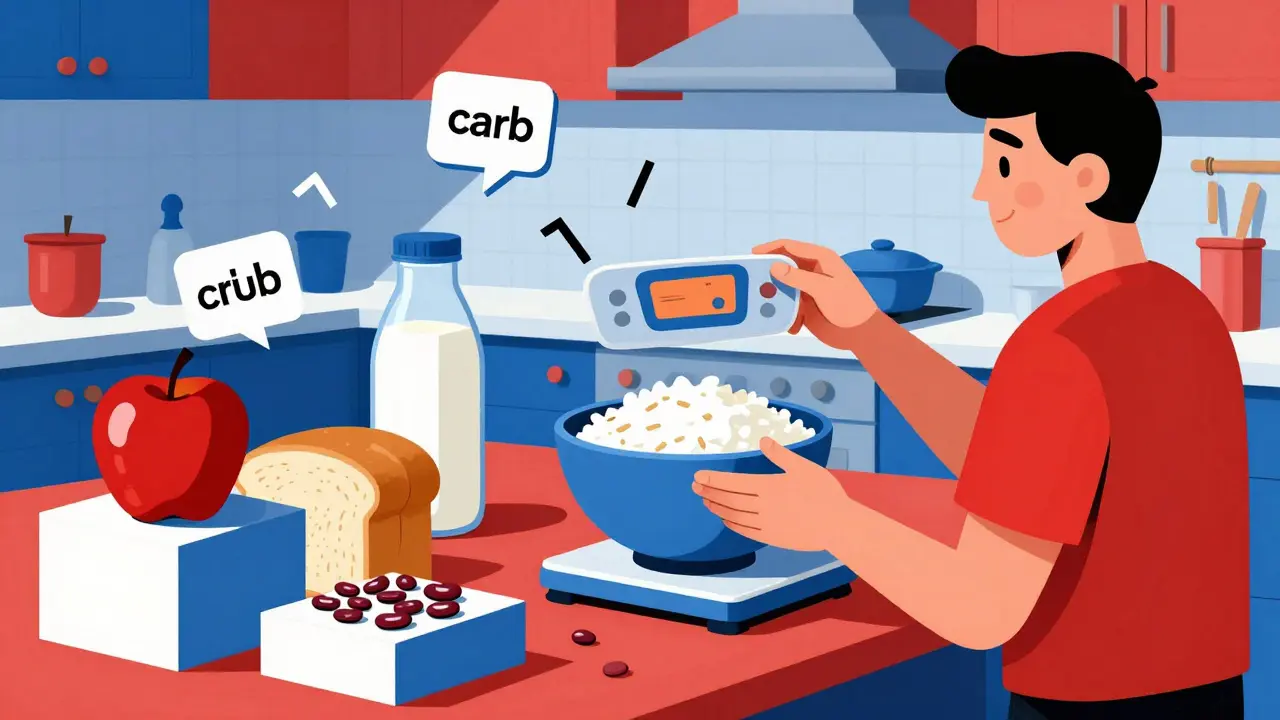
Managing diabetes doesn’t mean giving up your favorite foods. It means learning how to work with them. That’s where carbohydrate counting comes in. It’s not about cutting out carbs entirely. It’s about knowing exactly how much you’re eating so you can match it with your insulin or medication - and keep your blood sugar steady.
Why Carbohydrate Counting Matters
Carbs are the main nutrient that raises your blood sugar. Every slice of bread, every apple, every spoon of rice turns into glucose after you eat it. If you have diabetes, your body either doesn’t make enough insulin or can’t use it well. That means glucose builds up in your blood instead of being used for energy.Carb counting gives you control. Instead of guessing or following rigid meal plans, you track grams of carbs and adjust your insulin accordingly. This method is backed by the American Diabetes Association, the CDC, and major diabetes centers worldwide. Studies show people who count carbs regularly see their HbA1c drop by 0.5% to 1.0% - a meaningful improvement that lowers long-term risks like nerve damage, kidney problems, and heart disease.
It’s especially helpful if you take insulin - whether through multiple daily injections or an insulin pump. But even if you’re on oral meds, knowing your carb intake helps you understand why your blood sugar spikes or crashes after meals.
What Counts as One Carb Serving?
Carbs are measured in grams. One standard serving equals about 15 grams of total carbohydrates. That’s not arbitrary - it’s based on how much glucose 15 grams of carbs typically raise in most people.Here’s what 15 grams of carbs looks like in real food:
- 1 small apple (about 4 ounces)
- 1 slice of bread
- 1/2 cup of cooked rice or pasta
- 1/2 cup of beans or lentils
- 1 cup of milk
- 1/3 cup of oatmeal
- 1 small potato (about 2 ounces)
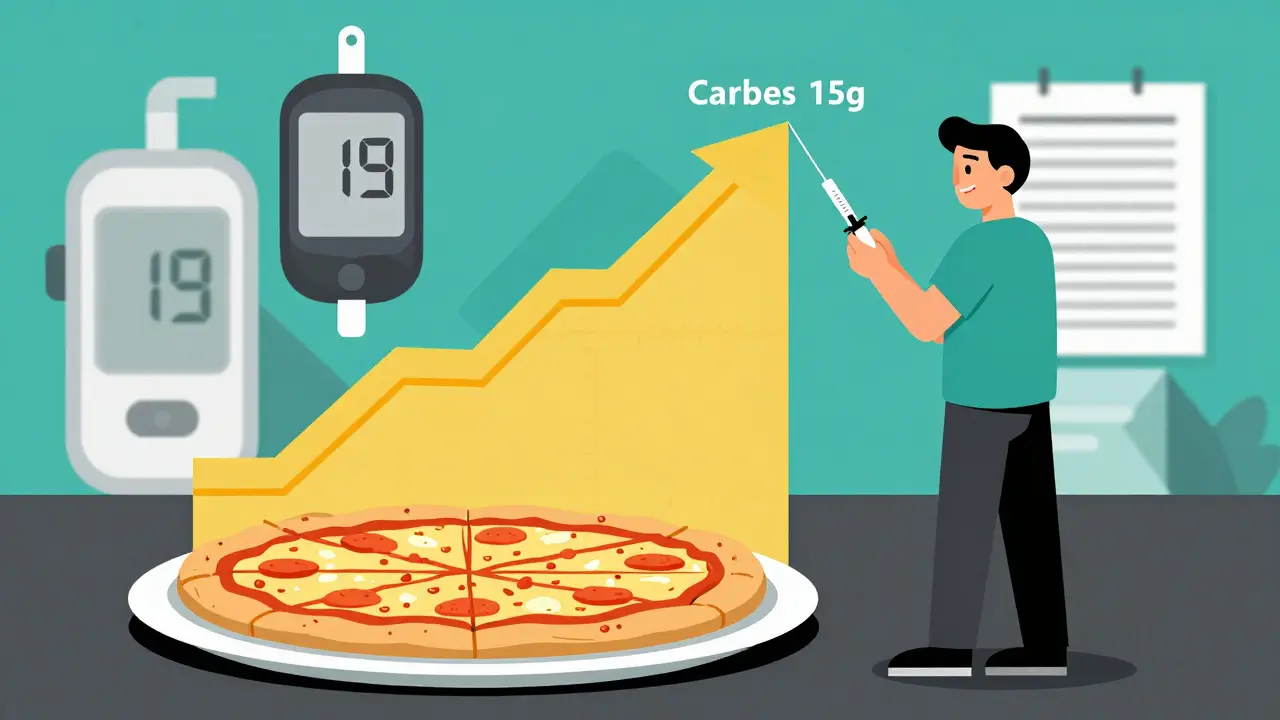
These aren’t strict rules - they’re starting points. The key is consistency. Once you know what 15 grams looks like, you can mix and match. Want pizza? Count the crust, sauce, and cheese. Craving yogurt? Check the label - plain Greek yogurt has fewer carbs than flavored versions.
How to Read a Nutrition Label
Labels are your best friend. Look for “Total Carbohydrates” - that’s the number you need. It includes sugar, starch, and fiber. Don’t be fooled by “sugar-free” claims. If the label says “18g total carbs,” that’s what you count, even if it says “0g added sugar.”Here’s how to adjust for fiber and sugar alcohols:
- Fiber: If a food has 5g or more of fiber, subtract the full amount from total carbs. Fiber doesn’t raise blood sugar.
- Sugar alcohols: These are found in sugar-free candies and gum. Subtract half their grams from total carbs. For example: 10g sugar alcohol → subtract 5g.
Example: A bar has 24g total carbs, 6g fiber, and 8g sugar alcohol.
Net carbs = 24 - 6 - (8 ÷ 2) = 24 - 6 - 4 = 14g
That’s less than one serving. You’d count it as 14g, not 24g.
Your Carb-to-Insulin Ratio
If you use insulin, you need to know your carb-to-insulin ratio. This tells you how many units of insulin you need per 15 grams of carbs.For example:
- A ratio of 1:10 means 1 unit of insulin covers 10g of carbs.
- A ratio of 1:15 means 1 unit covers 15g.
So if you eat 45g of carbs and your ratio is 1:15, you’d take 3 units of insulin (45 ÷ 15 = 3).
This ratio isn’t the same for everyone. It changes based on:
- Your insulin type (rapid-acting vs. long-acting)
- Time of day (many people need less insulin at breakfast)
- Physical activity
- Insulin sensitivity
Your doctor or certified diabetes educator will help you figure out your personal ratio. Don’t guess. Start with a conservative number and adjust based on your blood sugar results over several days.
Carb Counting vs. Other Methods
You might have heard of the plate method or glycemic index (GI). Here’s how carb counting stacks up:| Method | How It Works | Best For | Limitations |
|---|---|---|---|
| Carb Counting | Tracks exact grams of carbs; matches to insulin | People on insulin, especially pumps or MDI | Requires tools, learning curve, time investment |
| Plate Method | Divides plate into sections: 1/2 non-starchy veggies, 1/4 protein, 1/4 carbs | Beginners, those not on insulin | No exact numbers; less precise for insulin dosing |
| Glycemic Index | Focuses on how fast carbs raise blood sugar (low vs. high GI foods) | People wanting to avoid spikes | Doesn’t tell you how much to eat; confusing with mixed meals |
Carb counting wins for precision. If you’re on insulin, it’s the most reliable way to predict how your blood sugar will respond. The plate method is simpler but won’t help you dose insulin accurately. GI is useful for food choices but doesn’t give you the numbers you need for insulin.
Tools You Need to Start
You don’t need fancy gear. But you do need a few basics to get accurate:- A food scale (for meats, cheese, rice, etc.)
- Measuring cups and spoons
- A calculator (or phone app)
- A food diary or app (like MyFitnessPal or Carb Manager)
Start by measuring everything for at least 3 days. Write down what you eat, how much, and your blood sugar before and 2 hours after. You’ll be surprised how much you underestimate. A cup of rice? That’s actually 1.5 cups. A slice of bread? Maybe it’s two.
After 2-3 weeks, you’ll start estimating better. But even experienced counters use tools when trying new foods or eating out.
Common Mistakes and How to Avoid Them
Most beginners make these errors:- Forgetting hidden carbs: Milk in coffee, yogurt, sauces, starchy veggies (like peas or corn) - these add up fast. About 25% of daily carbs come from these sources.
- Guessing restaurant meals: Chains often list inaccurate carb counts. A “small” burger bun might be 40g, not 25g. Always assume it’s higher than listed.
- Not adjusting for insulin timing: If you take insulin 15 minutes before eating, but eat 30 minutes late, your blood sugar will spike.
- Ignoring activity: Exercise lowers blood sugar. If you walk after dinner, you may need less insulin for the same meal.
Keep a log. Share it with your diabetes educator. They’ll spot patterns you miss.
Real-Life Success Stories
One person on Reddit tracked their carbs for 30 days and saw post-meal spikes drop from 250+ mg/dL to 160-180 mg/dL. Another, diagnosed with type 1 diabetes at 19, lowered their HbA1c from 8.9% to 6.2% over 18 months using carb counting and a pump.It’s not magic. It’s consistency. The first month is the hardest. People spend 30-60 minutes per meal tracking. But after that, it becomes automatic. You learn your favorite foods’ carb counts. You memorize portions. You start to predict how your body responds.
When Carb Counting Might Not Be Right for You
It’s not the only way. If you have type 2 diabetes and manage it with diet, metformin, or GLP-1 agonists, you might not need precise counting. The plate method or portion control may be enough.But if you’re on insulin - especially multiple daily injections or a pump - carb counting is the gold standard. It’s taught in 92% of ADA-recognized diabetes education programs. And with continuous glucose monitors (CGMs), you can see in real time whether your carb estimates were right.
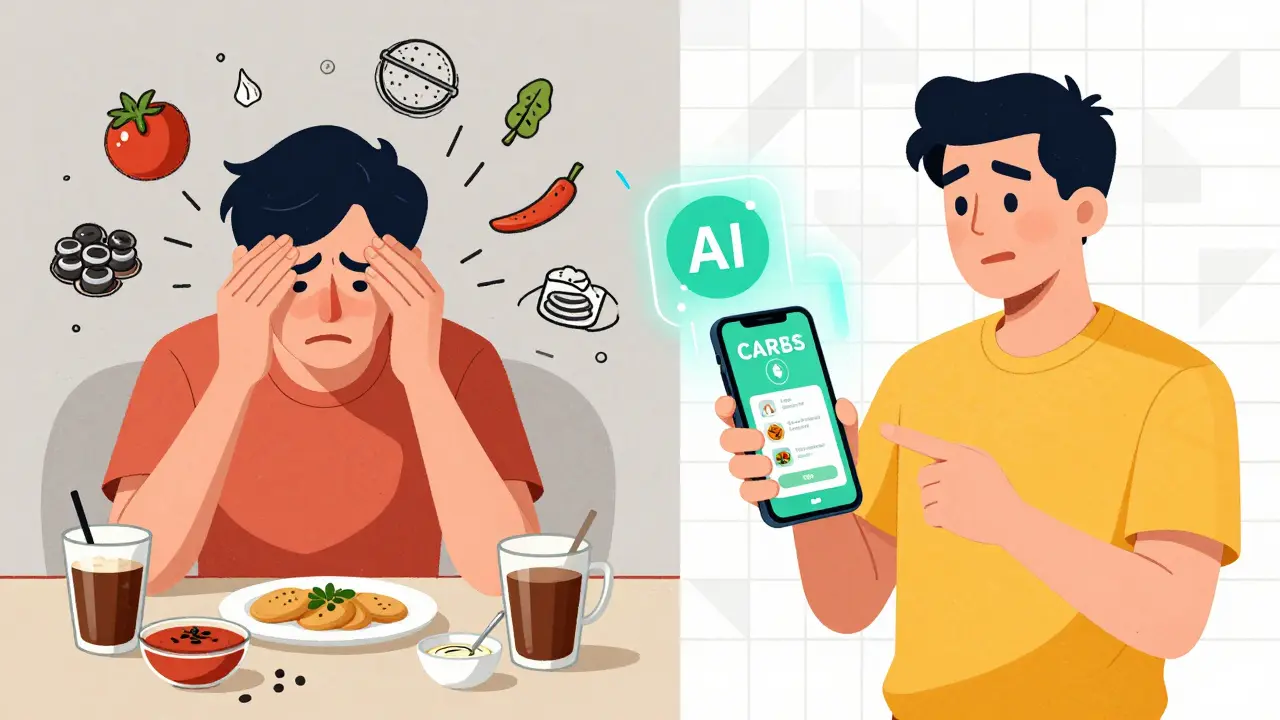
Modern tools are making it easier. Apps like Carb Manager use AI to scan food photos and estimate carbs with 85% accuracy. The USDA’s FoodData Central has over 300,000 entries. You can look up almost anything.
What to Eat: Quality Matters Too
The ADA now emphasizes not just quantity, but quality. Not all carbs are equal.Choose:
- Whole grains (oats, quinoa, brown rice)
- Fruits and vegetables (especially non-starchy ones like spinach, broccoli, peppers)
- Legumes (beans, lentils, chickpeas)
- Dairy without added sugar (plain yogurt, unsweetened milk)
Avoid or limit:
- White bread, pastries, sugary cereals
- Soda, juice, sweetened coffee drinks
- Processed snacks (chips, cookies, candy)
Why? Fiber and protein slow down sugar absorption. That means fewer spikes and more stable energy. You can still enjoy a slice of cake - just count the carbs, adjust your insulin, and enjoy it mindfully.
Getting Started: Your 4-Week Plan
Week 1:Measure everything. Use cups, spoons, a scale. Log every bite. Don’t judge - just record. Week 2:
Learn your carb servings. Practice converting portions to grams. Use the 15g rule as a reference. Week 3:
Start using your insulin ratio. Calculate doses before meals. Check your blood sugar 2 hours later. Did it land between 100-140 mg/dL? Adjust next time. Week 4:
Try eating out. Look up menus ahead of time. Estimate carbs. Then check your blood sugar. See how close you were.
By the end of four weeks, you’ll be more confident. You won’t need to measure every spoonful. But you’ll know when to double-check - and when to trust your gut.
Final Thought: It’s a Skill, Not a Restriction
Carb counting isn’t about perfection. It’s about awareness. You’ll have days when you miscalculate. You’ll eat a meal that spikes your sugar. That’s okay. What matters is that you learn from it.This method gives you freedom - to eat pizza, celebrate birthdays, travel, and enjoy meals with family - without fear. You’re not controlling your life. You’re taking charge of your health.





12 Comments
I tried this for a month and it was a nightmare. I spent more time calculating carbs than eating. My wife started bringing me snacks when I wasn't looking just to see if I'd catch it. I lost 12 pounds in 3 weeks not because I was healthy but because I stopped eating altogether. Then my sugar went nuts. Don't let anyone tell you this is easy.
Carb counting works if you're disciplined. I've been doing it for 7 years with type 1. The first month is brutal, but after that, you just know. My HbA1c dropped from 8.1 to 6.3. No magic, just math.
This is the most practical guide I've ever read on diabetes management. No fluff, no fear-mongering, just clear steps. If you're on insulin, this is your roadmap.
Let me break this down for you folks who think this is revolutionary. The ADA has been pushing this since the 90s. What’s new? Apps that auto-scan food? That’s just tech repackaging old advice. The real issue? Most people don’t have the time or mental bandwidth to track every bite. This works for the privileged who can afford scales and apps. For the rest of us? It’s just another guilt trip wrapped in science.
Who’s really behind this carb counting hype? Big Pharma. They want you to think you need insulin for every slice of bread. I’ve been off meds for 3 years with just keto and apple cider vinegar. The FDA won’t tell you this because they’re paid off. Look up the 2018 Senate hearings on insulin pricing - they buried it.
Why are we even doing this? Just eat less sugar and stop being lazy. I know people who eat pizza every night and their sugar is fine. You don't need a calculator to live. This guide is overkill. I don't even own a food scale and I'm fine
Carb counting is only useful if you're on insulin. If you're on metformin or GLP-1s, you're wasting your time. The real problem is that doctors push this on everyone like it's one-size-fits-all. Most type 2s don't need this level of precision. You're just creating anxiety. The plate method is enough for 90% of people. Stop overcomplicating it.
Why do Americans think everything needs a spreadsheet? In India, we just eat food and move on. My uncle has type 2 and he eats rice three times a day. His sugar? Stable. Why? Because he walks 8km daily and doesn't sit on his ass. You're treating a lifestyle disease with a math problem. Fix the lifestyle, not the math.
So you're telling me I can eat a donut if I count the carbs and take insulin? That’s not empowerment. That’s a pharmaceutical trap. You're training people to rely on drugs instead of changing their relationship with food. This isn’t freedom - it’s chemical obedience dressed up as control.
I’ve been doing this for 10 years. The first year was hell. I cried over measuring cups. I hated my life. But now? I can eat at any restaurant, travel anywhere, and still feel in control. I don’t measure every spoonful anymore. I just know. It’s not about perfection. It’s about knowing you can handle it when things go wrong. That peace? Worth every minute of the grind.
While the methodology presented is ostensibly grounded in empirical nutritional science, one cannot ignore the epistemological hegemony of quantification in contemporary medical discourse. The reduction of dietary experience to discrete grammatical units, while statistically expedient, fundamentally alienates the phenomenological essence of alimentary pleasure - a tacit commodification of bodily autonomy under the auspices of biomedical governance. One must ask: is this truly liberation, or merely a more sophisticated form of dietary surveillance?
I used to hate this. Now I don’t even think about it. I just know my portions. I eat a bowl of oatmeal for breakfast, a salad with chicken for lunch, and fish with veggies for dinner. Sometimes I have a cookie. I don’t panic. I check my sugar. If it’s high, I walk. If it’s good, I eat again tomorrow. It’s not a diet. It’s just how I live now.