
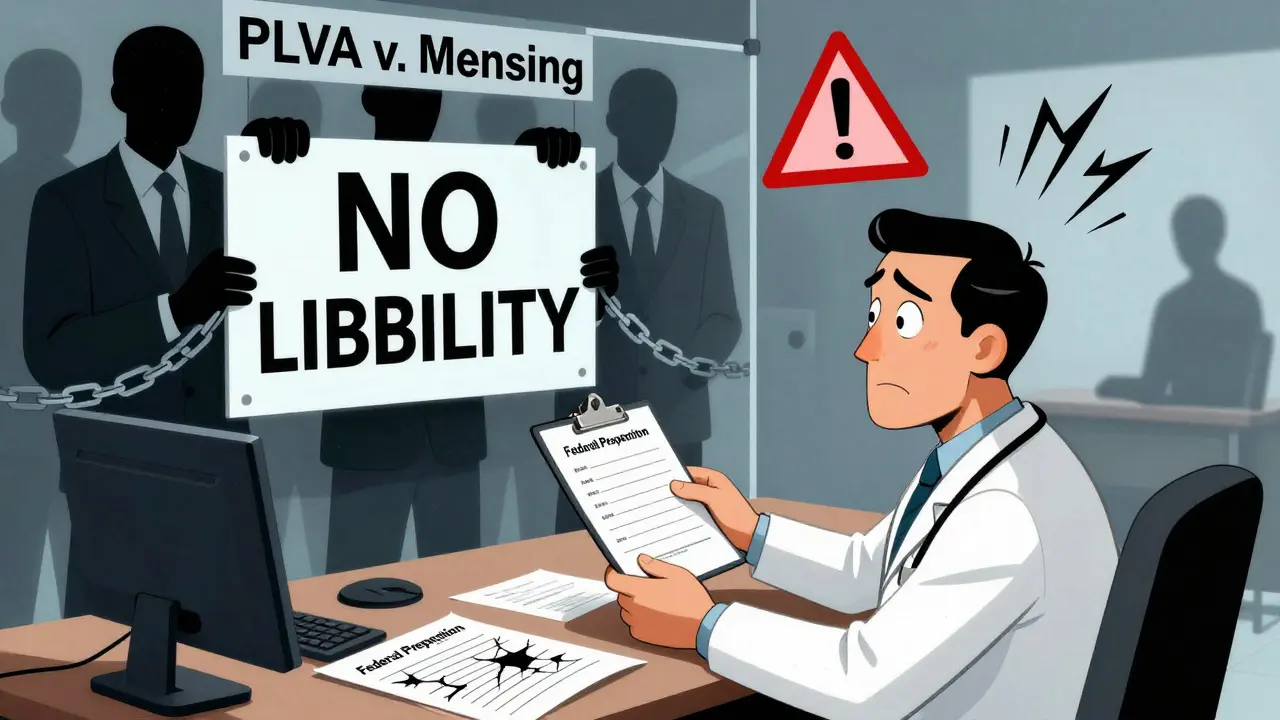
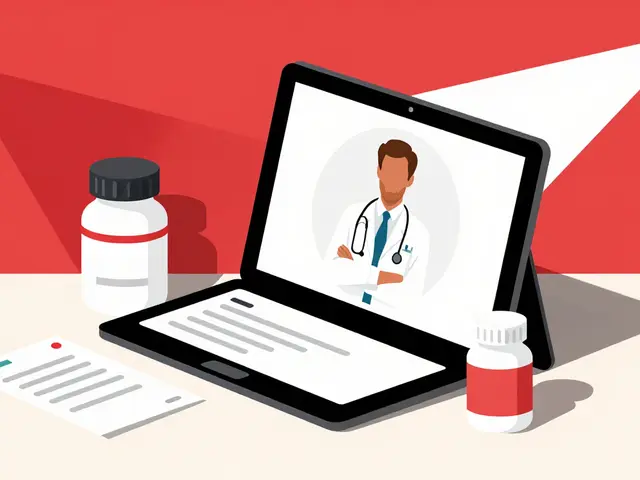
When a doctor writes a prescription for a generic drug, they might think they’re doing the right thing-saving money, following guidelines, helping patients afford treatment. But behind that simple act lies a growing legal minefield. In the last decade, courts have shifted responsibility for generic drug injuries almost entirely onto physicians. If a patient is harmed by a generic medication, the company that made it often can’t be sued. That leaves the prescribing doctor as the only target left.
Why Generic Drug Manufacturers Can’t Be Sued
It starts with a 2011 Supreme Court case: PLIVA, Inc. v. Mensing. The ruling said generic drug makers can’t be held liable for failing to update warning labels, even if new safety data emerges. Why? Because federal law forces them to copy the brand-name drug’s label exactly. They can’t change it on their own. A few years later, in Mutual Pharmaceutical Co. v. Bartlett, the Court doubled down. A woman named Karen Bartlett developed a devastating skin condition after taking generic sulindac. She lost 65% of her skin, spent 50 days in a burn unit, and was permanently disfigured. She sued the manufacturer. The Supreme Court said no-because the company had no legal right to change the label, it couldn’t be held responsible.This is now called the Mensing/Bartlett Preemption. It created a legal black hole. Patients hurt by generic drugs have almost nowhere to turn. Manufacturers are immune. Pharmacists are just filling orders. That leaves the physician-who wrote the prescription-as the only person with legal exposure.
What Doctors Are Liable For
Physicians aren’t automatically liable just because they prescribed a generic. But they can be held responsible if three things are proven: duty, dereliction, and direct cause.- Duty: The doctor-patient relationship creates a legal obligation to provide care that meets accepted medical standards.
- Dereliction: The doctor’s actions-or lack of action-fell below that standard. For example, failing to warn about known side effects like drowsiness, liver damage, or skin reactions.
- Direct cause: The harm was directly caused by the medication. No other factor, like a car crash or pre-existing condition, can reasonably explain the injury.
Take the case of Coombes v. Florio. A patient was prescribed a drug known to cause drowsiness. The doctor didn’t warn them not to drive. The patient crashed their car. The court found the doctor liable. The same logic applies to generics. If a patient develops Stevens-Johnson syndrome after taking a generic anticonvulsant, and the doctor never mentioned the risk-especially if it’s listed in the FDA’s black box warning-they’re at risk.
State Laws Create a Patchwork of Risk
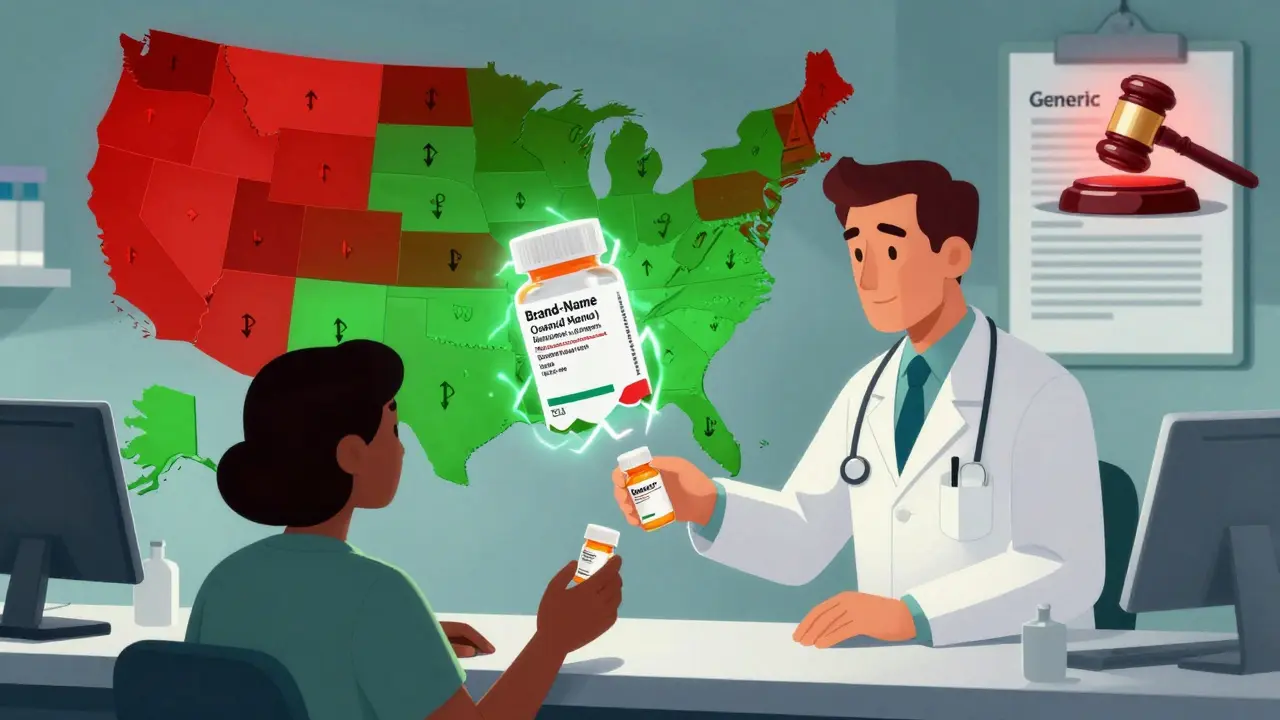
Forty-nine states allow pharmacists to substitute generic drugs unless the doctor writes “dispense as written” or “do not substitute.” But here’s where it gets messy:- Thirty-two states require pharmacists to notify the prescribing doctor within 72 hours of a substitution.
- Seventeen states don’t require any notification at all.
That means a doctor might prescribe a brand-name drug, thinking they’re in control. But if the pharmacist swaps it out without telling them, and the patient gets hurt, the doctor might still be sued-even if they had no idea a generic was dispensed.
Some states try to fix this. Illinois, for example, ruled in Guvenoz v. Target Corp. that generic manufacturers do have a duty to change their labels if a drug is inherently dangerous. That’s an exception to federal preemption. In Illinois, doctors might face less liability because the manufacturer still has legal exposure.
But in most other states? The manufacturer is off the hook. The doctor is on the hook.
Defensive Prescribing Is Real-and Costly
A 2022 survey of 1,200 physicians by the American Medical Association found that 68% felt more anxious about prescribing generics. Forty-two percent admitted they sometimes choose the more expensive brand-name drug-not because it’s better, but because they’re scared of being sued.One doctor in Massachusetts told colleagues he now adds 15 to 20 minutes to every visit just to document side effect warnings. He writes them out in plain language: “I discussed with you that [medication] can cause severe skin reactions. Avoid sun exposure. Report blisters or rash immediately.”
Electronic health records have caught on. Epic Systems added mandatory fields in 2021 requiring physicians to document discussions about generic substitution. If you don’t fill them out, the system won’t let you sign off.
And it’s not just time-it’s money. Liability insurers now charge an average 7.3% higher premium for doctors who routinely allow substitutions without detailed documentation. That’s hundreds, sometimes thousands, of extra dollars per year.
What You Must Document
If you’re prescribing a generic-and you will be, since 90% of prescriptions in the U.S. are generics-you need to document like your license depends on it. Here’s what works:- For high-risk drugs (warfarin, levothyroxine, lithium, seizure meds): Always write “dispense as written.”
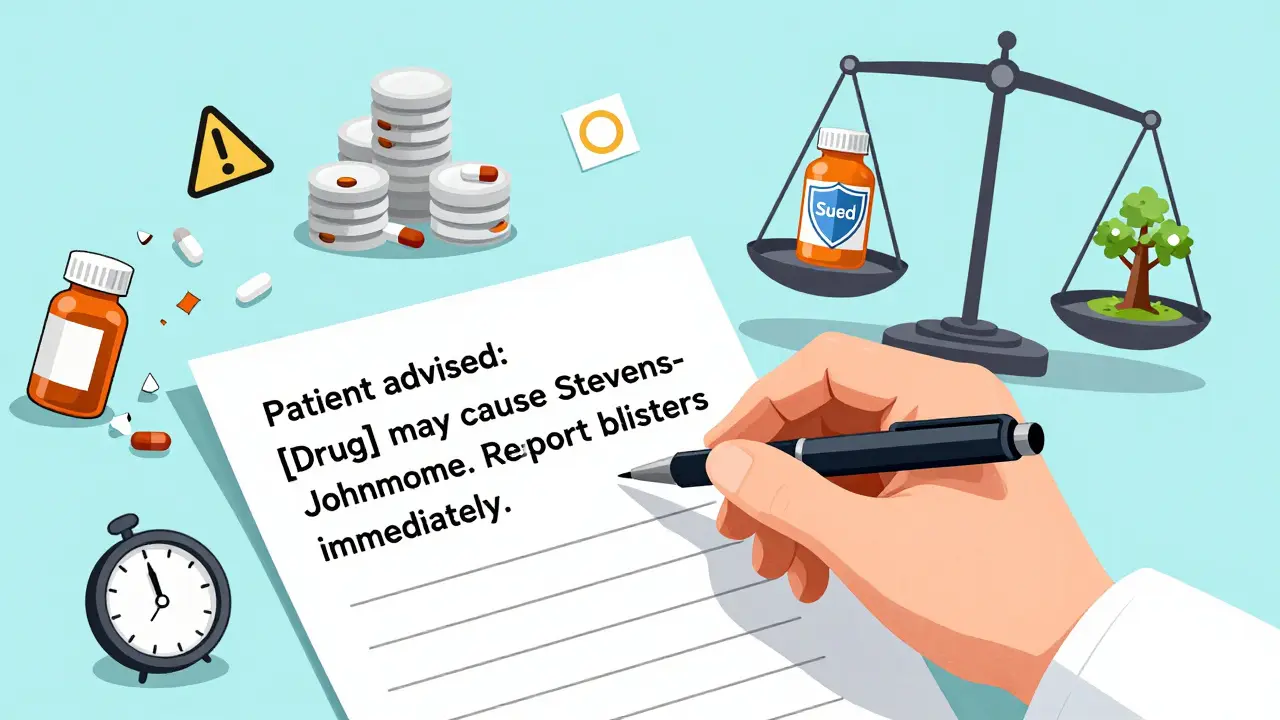
- For any drug with known serious side effects: Write out the risk in plain language. Don’t say “medication discussed.” Say: “Patient advised that [drug] may cause liver damage. Must report nausea, dark urine, or yellowing skin immediately.”
- For patients with a history of adverse reactions: Note it. “Patient previously had Stevens-Johnson syndrome to brand-name version. Avoid all analogs.”
- For drugs with recent FDA warnings: Print and attach the warning. Include it in the chart.
Studies show doctors who document specific, detailed counseling reduce their liability exposure by 58%. Generic notes like “patient educated on meds” won’t cut it. Courts want specifics.
The Bigger Picture
Generic drugs save patients and insurers billions. That’s not in dispute. But the legal system hasn’t kept up. While 90% of prescriptions are generic, liability law still treats them as second-class citizens. Manufacturers are shielded. Pharmacists are just distributors. The physician? They’re the last line of defense.Lawmakers have tried to fix this. The proposed Preserving Access to Prescription Medications Act would restore some liability options for patients. But it’s stuck in committee. Meanwhile, lawsuits against doctors have jumped 37% since 2014.
And it’s getting worse. The 9th Circuit Court of Appeals made a small crack in the wall in 2023 with Johnson v. Teva Pharmaceuticals. They ruled that if a brand-name manufacturer updates its warning label, and the generic maker ignores it, the generic company might be liable. It’s a narrow exception, but it’s a start. Still, most cases will continue to land on physicians.
What’s Next?
The American Medical Association is pushing for state laws requiring pharmacists to notify doctors within 24 hours when a substitution happens-especially for high-risk drugs. Eighteen states have introduced such bills in 2023. If they pass, doctors might get some breathing room.But until then, the rule is simple: If you prescribe a generic, you own the risk. The manufacturer won’t be sued. The pharmacist won’t be sued. You will be.
Don’t assume patients understand the risks. Don’t assume they’ll read the pill bottle. Don’t assume the pharmacy will tell you. Document everything. Be specific. Be thorough. And when in doubt-write “dispense as written.”
Can I be sued if a pharmacist substitutes a generic without my permission?
Yes. In most states, pharmacists are allowed to substitute generics unless you explicitly write “dispense as written.” If they do substitute and the patient is harmed, you can still be held liable-especially if you didn’t document the risks of the drug. The fact that you didn’t authorize the substitution doesn’t protect you. The law holds you responsible for the medication you prescribed, regardless of what was dispensed.
Do I need to warn patients differently for generics versus brand-name drugs?
Yes. The same drug-whether brand or generic-has the same active ingredient and risks. But because generic manufacturers can’t update labels, patients often rely entirely on the prescribing physician for safety information. You must discuss side effects, black box warnings, and contraindications regardless of whether the drug is brand or generic. Failing to do so increases your liability risk.
Which drugs are highest risk for liability?
Drugs with narrow therapeutic indices and serious known side effects are the most dangerous. These include warfarin (blood thinner), levothyroxine (thyroid hormone), lithium (for bipolar disorder), phenytoin and carbamazepine (anti-seizure drugs), and methotrexate (for autoimmune conditions). Even small changes in dosage or formulation can cause toxicity or treatment failure. Always write “dispense as written” for these.
Why don’t generic manufacturers update their labels?
Federal law requires generic manufacturers to use the same label as the brand-name drug. They can’t change it without FDA approval-and the FDA won’t approve changes unless the brand-name maker changes first. This creates a deadlock. If the brand-name maker doesn’t update the label, the generic can’t either-even if new safety data emerges. This is the core reason courts have shielded them from liability.
Is prescribing brand-name drugs always safer legally?
Not necessarily. You still have the same duty to warn and monitor. But if a patient is harmed by a brand-name drug, the manufacturer can be sued. That means liability is shared. With generics, the manufacturer is immune. So while prescribing brand-name doesn’t eliminate your liability, it does reduce your risk of being the only target in a lawsuit.


9 Comments
Doctors are now the human liability shields for Big Pharma.
And we wonder why people are scared to prescribe generics.
It's not about medicine anymore. It's about who gets to carry the legal bag.
But here's the kicker-patients don't read the warnings either.
So who's really at fault? The doc who didn't write it down? Or the system that lets a $0.10 pill cause a $10M lawsuit?
When federal preemption blocks manufacturer accountability and state laws create patchwork notification standards, you don't get justice-you get litigation roulette.
Doctors aren't the problem. The architecture of the system is.
But I've had three lawsuits.
So yeah. I document like my license depends on it.
Because it does.
And yet, we still call it 'affordable healthcare.'
Now I can't even close the chart without checking off:
• Risk discussed
• Patient acknowledged
• Written warning attached
Feels like I'm doing paperwork for a robot, but at least now I sleep at night 😅
I just got a new patient on carbamazepine.
Wrote out the whole damn warning like I’m writing a love letter.
‘If your skin turns into a raisin, call me. Like, right now.’
They looked at me weird.
Worth it.