

Think about the last time you squinted to read a sign across the street or struggled to see the TV without leaning forward. If this sounds familiar, you’re not alone. Roughly 54% of adults between 40 and 69 have some kind of refractive error - a simple optical flaw that keeps light from landing perfectly on the retina. The result? Blurry vision. But here’s the good news: we know exactly how to fix it. Whether it’s glasses, contacts, or laser surgery, modern solutions can restore sharp vision for most people. Let’s break down the three main types - myopia, hyperopia, and astigmatism - and how they’re corrected today.
What Is Myopia, and Why Is It So Common?
Myopia, or nearsightedness, means you can see things up close clearly, but distant objects look fuzzy. It happens when your eyeball is too long - longer than the standard 24mm in adults - or when your cornea is too curved (over 43 diopters). Light focuses in front of the retina instead of directly on it. This isn’t just a minor inconvenience. In parts of East Asia, up to 90% of young adults are myopic. In Australia, rates are climbing fast, especially in kids who spend less time outdoors.
Doctors have known for years that too much screen time and not enough natural light during childhood can speed up myopia progression. The National Eye Institute found that kids who spend at least two hours outside every day develop myopia at a much slower rate. Once it starts - usually around age 10 - it often gets worse each year until the late teens. That’s why regular eye checks are critical during these years.
Correction is straightforward: minus (-) power lenses. These are the thin, concave lenses in glasses or contacts that bend light outward before it enters the eye, helping it land right on the retina. But for some, especially those with high myopia (over -6.00 diopters), the risks go beyond blurry vision. They face a 5 to 10 times higher chance of retinal detachment or degeneration. That’s why managing myopia early isn’t just about seeing better - it’s about protecting long-term eye health.
Hyperopia: When Your Eyes Are Too Short
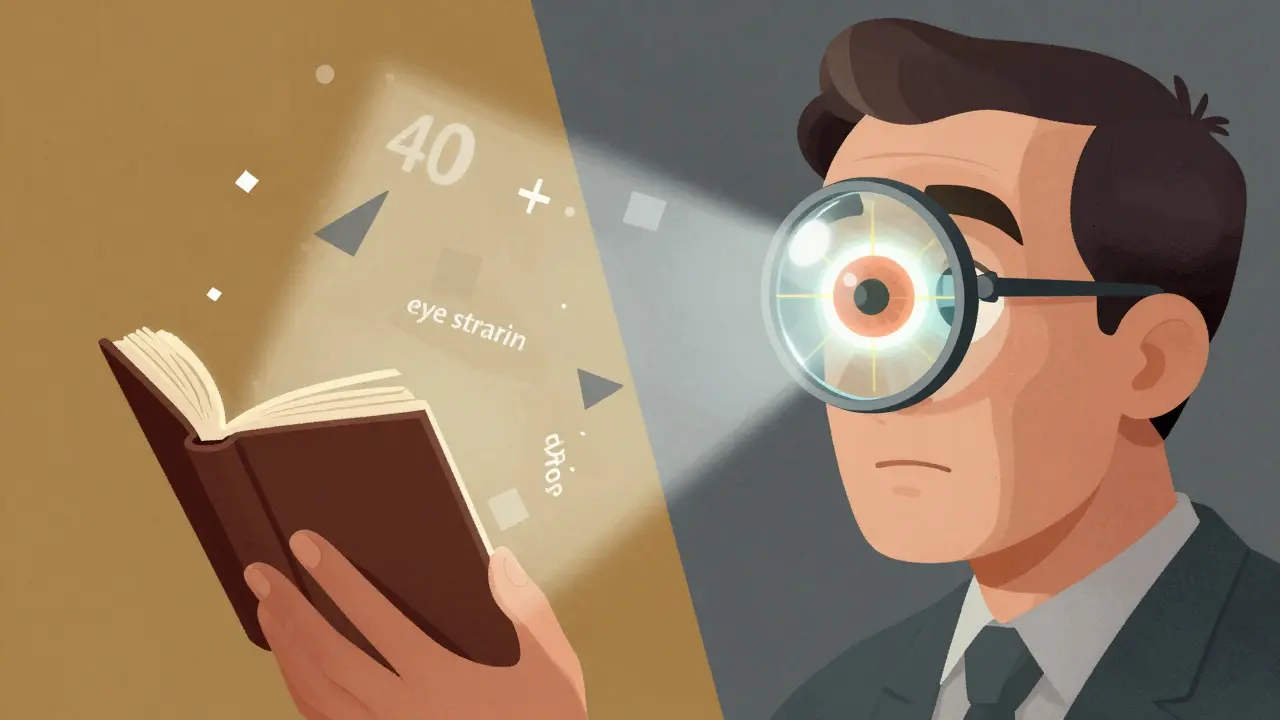
Hyperopia, or farsightedness, is the opposite. Your eyeball is too short - under 22mm - or your cornea is too flat (less than 40 diopters). Light focuses behind the retina, making close-up tasks like reading or using a phone hard. You might not notice it as a kid because your eye’s natural focusing power can compensate. But as you get older - especially after 40 - that ability fades, and suddenly, everything up close looks blurry.
It’s more common than you think. About 5 to 10% of Americans are farsighted, and the rate jumps to 25% among Native American populations. Unlike myopia, hyperopia doesn’t always start in childhood. Many people live for years without realizing they have it. Symptoms? Eye strain, headaches after reading, and trouble with fine details. You might find yourself holding books farther away or squinting at your phone.
Correction uses plus (+) lenses - thicker, convex lenses that bend light inward before it enters the eye. These help focus the image correctly on the retina. Glasses are the most common fix, but contacts work just as well. For older adults, progressive lenses are often recommended because they handle both distance and near vision in one pair. If you’re over 40 and suddenly struggling with reading, it’s not just aging - it could be hyperopia catching up to you.
Astigmatism: The Eye That’s Not a Perfect Sphere
Astigmatism is different. It’s not about the length or shape of the whole eye - it’s about the cornea or lens being irregular, like a football instead of a basketball. This causes light to focus on multiple points instead of one. The result? Blurry or distorted vision at any distance. You might see double images, notice streaks around lights at night, or feel constant eye strain.
It’s incredibly common - affecting 30 to 60% of the population. Many people have mild astigmatism and don’t even know it. But when it’s stronger, it can make driving at night a nightmare. One Reddit user described it as “looking through water” until their optometrist adjusted the cylinder axis to exactly 175 degrees. That’s the key: astigmatism correction isn’t just about power. It needs a specific axis and cylinder value, measured in degrees and diopters.
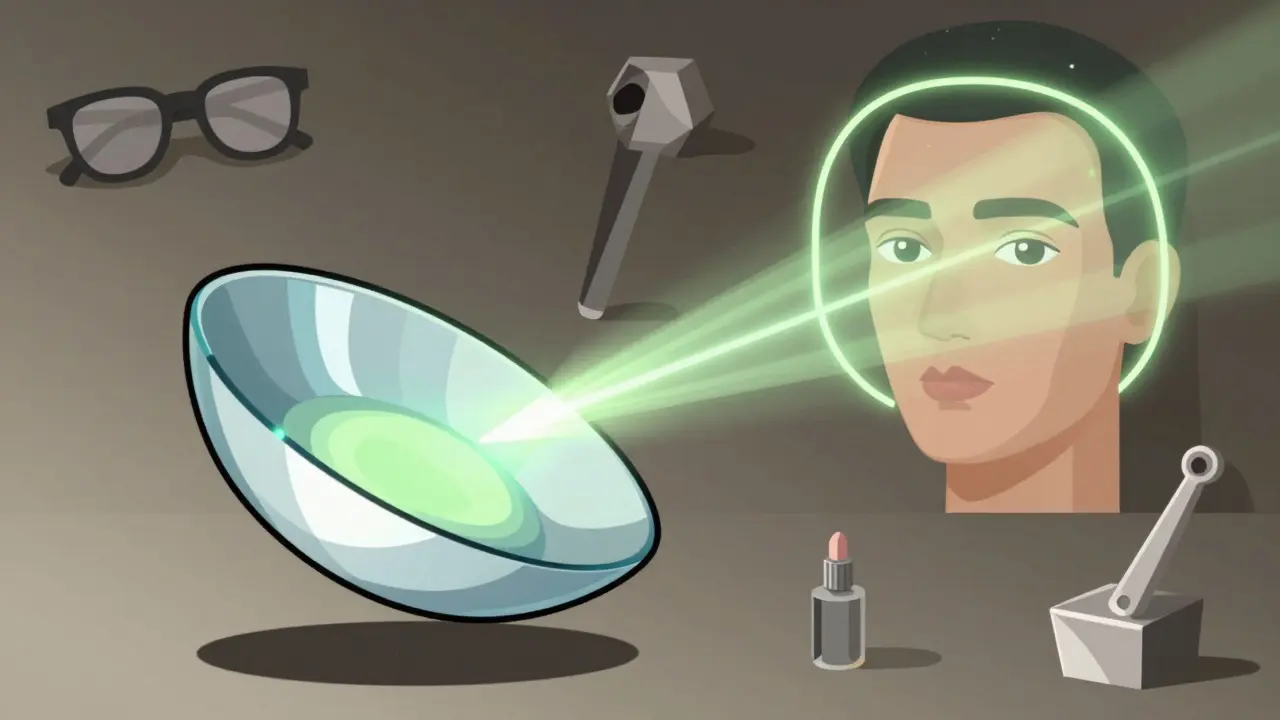
Corrective lenses for astigmatism are called toric lenses. They have two powers in one - one to fix the curvature, another to correct the direction. Glasses with toric lenses can take a few weeks to adjust to. Contacts? Even longer. Some people report discomfort for up to a month. But once it’s right, the difference is dramatic. Modern wavefront-guided LASIK can map your eye’s unique irregularities and correct astigmatism with precision down to 0.25 diopters.
How Do You Choose Between Glasses, Contacts, and Surgery?
You have three main options: glasses, contacts, and surgery. Each has trade-offs.
Glasses are the easiest. No training, no risk of infection. You get clear vision the moment you put them on. Most people adapt in 2 to 3 days. For astigmatism, it might take up to three weeks. Satisfaction scores are high - 4.2 out of 5 on review sites. But they can fog up, slip down your nose, or break. And if you’re active, they can be a hassle.
Contacts give a wider field of view. No frames, no reflections. But they come with risks. The CDC reports that 3 to 4% of contact wearers develop microbial keratitis - a serious eye infection - each year. Daily disposables reduce that risk, but you still need to clean them properly. Many users complain of discomfort after 8 hours. For astigmatism, toric contacts are trickier to fit and can rotate out of place. But for people who hate glasses, they’re worth the effort.
Refractive surgery - LASIK, PRK, SMILE - offers freedom from glasses and contacts. LASIK, approved by the FDA in 1995, reshapes the cornea with a laser. SMILE, a newer option, uses a smaller incision and causes fewer dry eye issues. Satisfaction rates? 4.5 out of 5. But it’s not for everyone. You need a stable prescription for at least a year, corneas thicker than 500 microns, and to be over 18. About 20 to 40% of patients get dry eyes after surgery, and some see halos or glare at night. Still, for many, the trade-off is worth it.
What’s New in Refractive Error Treatment?
It’s not just about fixing vision anymore - we’re trying to stop it from getting worse. For kids with rapidly progressing myopia, orthokeratology (Ortho-K) lenses are becoming popular. These are rigid contacts worn overnight that gently reshape the cornea. Studies show they can reduce myopia progression by 36 to 56%.
Another breakthrough? Low-dose atropine eye drops. Used daily at concentrations of 0.01% to 0.05%, they’ve been shown to slow myopia progression by 50 to 80% over two years. They’re safe, easy to use, and now widely prescribed in Australia and Asia.
On the surgical side, SMILE is growing fast. It’s less invasive than LASIK, with fewer dry eye complaints. Experts predict a 15% annual increase in SMILE procedures through 2028. Meanwhile, wavefront-guided technology is making custom corrections more accurate than ever - especially for complex astigmatism cases.
When Should You See a Specialist?
You don’t need to wait for symptoms to get worse. If you’re a child and your vision seems to be getting worse each year, get checked. If you’re over 40 and suddenly struggling to read, schedule an eye exam. If you’re noticing halos, double vision, or headaches after screen time, don’t ignore it.
Refractive errors are among the most treatable conditions in medicine. Left uncorrected, they can affect learning, safety, and quality of life. The World Health Organization says over 123 million people worldwide have moderate to severe vision loss because their refractive errors weren’t fixed. That’s preventable.
Whether you’re 8 or 80, the right correction is out there. You just need to find it.
Can refractive errors get worse over time?
Yes, especially myopia in children. It often progresses until the late teens or early 20s. Hyperopia may become more noticeable after 40 as the eye’s natural focusing power declines. Astigmatism usually stays stable, but it can change slightly with age. Regular eye exams are key to catching changes early.
Is LASIK safe for people with astigmatism?
Absolutely. Modern LASIK and SMILE procedures use wavefront-guided mapping to correct astigmatism with high precision. Surgeons can address both the curvature and axis of irregular corneas. Many patients with moderate to severe astigmatism report excellent results - often better than with glasses or contacts.
Do I need to wear glasses forever if I have myopia?
Not necessarily. While glasses or contacts are the standard correction, refractive surgery like LASIK or SMILE can permanently reshape your cornea to reduce or eliminate dependence on them. For kids, ortho-k lenses or low-dose atropine drops can slow progression, potentially reducing the need for strong prescriptions later.
Why do my new glasses make everything look curved?
This is common with high prescriptions or new astigmatism corrections. The lenses bend light in a way your brain isn’t used to. It usually clears up in 3 to 14 days. If it lasts longer, your prescription might be off - especially the cylinder axis. Go back to your optometrist. A small adjustment can make a big difference.
Can children outgrow refractive errors?
Some kids with mild hyperopia may outgrow it as their eyes grow longer. But myopia almost never goes away on its own - it usually gets worse without intervention. Astigmatism typically stays stable. Early correction is critical for visual development in children. Delaying glasses can lead to lazy eye or permanent vision problems.
What Should You Do Next?
If you’ve been putting off an eye exam - now’s the time. A simple 15-minute check can tell you if you have a refractive error, how serious it is, and what your options are. Don’t assume blurry vision is just “getting older.” It could be something fixable.
For parents: Watch for signs in kids - squinting, sitting too close to the TV, rubbing eyes, or avoiding reading. Get them checked by age 3 and again before starting school. Early detection can prevent lifelong issues.
And if you’re considering surgery, don’t rush. Make sure your prescription has been stable for at least a year. Talk to a surgeon about your lifestyle. Athletes, swimmers, or people in dusty jobs might prefer SMILE over LASIK. Ask about dry eye risks and night vision changes.
Refractive errors are common, but they’re not inevitable. With the right correction, you can see the world clearly - without strain, without guesswork, without limits.



8 Comments
Myopia is a modern plague caused by kids staring at screens instead of looking at horizons. We used to play outside until dark-now they’re glued to tablets. It’s pathetic. And don’t get me started on how the NHS can’t even keep up with prescriptions. We need discipline, not fancy drops.
The data presented here is statistically robust and clinically significant. Myopia prevalence in East Asia correlates strongly with urbanization and reduced time spent in natural light, as confirmed by longitudinal studies from the Singapore National Eye Centre. The use of orthokeratology and low-dose atropine represents a paradigm shift in pediatric ophthalmology, moving from correction to prevention.
Imagine a world where your eyes don’t betray you-where the stars aren’t blurred by a faulty lens, and the face of your child isn’t a smudged watermark. 🌟 That’s what modern optics do. From the delicate dance of toric lenses to the silent precision of SMILE lasers, we’re not just fixing vision-we’re restoring wonder. Every child who sees the moon clearly today is a small miracle engineered by science.
It’s funny how something so simple-light hitting the right spot-can change everything. I used to think glasses were a sign of weakness, until I realized they were just a bridge between me and the world. My daughter’s myopia was caught early, thanks to a school screening. Now she’s outside every day, chasing butterflies, and her prescription hasn’t budged in two years. Sometimes the best tech isn’t a laser-it’s a pair of shoes and a park.
For all my fellow parents out there: if your kid squints at the TV, don’t just say ‘they’re fine’ 😊 Get them checked! I waited too long with my son-he was struggling in class and I thought it was ‘just being distracted.’ Turns out, he needed astigmatism correction. After two weeks in new glasses? He started reading books for fun. 🥹 Vision is freedom.
The claim that 90% of young adults in East Asia are myopic requires contextual nuance. Population density, educational pressure, and indoor schooling are confounding variables. Moreover, the FDA’s approval of SMILE in 2016 does not equate to universal superiority over LASIK. Long-term corneal biomechanical data beyond five years remains limited. Prudent clinical judgment must prevail over marketing narratives.
Let’s be clear: this isn’t ‘vision correction’-it’s a medical-industrial complex profiting off laziness. Kids don’t need atropine drops; they need to be forced outside. LASIK isn’t ‘revolutionary’-it’s a $$$ scam for people too lazy to wear glasses. And don’t get me started on ‘toric lenses’-they’re just fancy marketing for a basic shape. We used to fix things with discipline, not dollars. This is weakness dressed up as progress.