
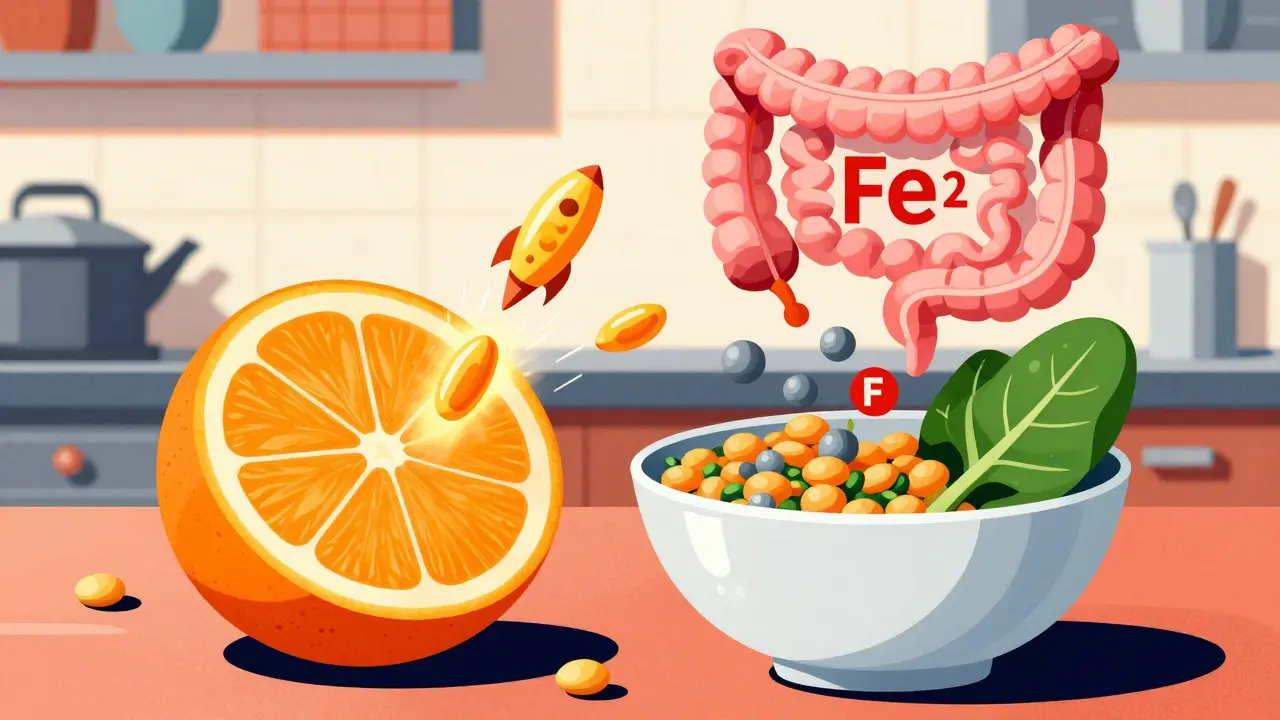
When you take an iron supplement or eat iron-rich plant foods like spinach, lentils, or fortified cereal, you’re not just getting iron-you’re setting up a chemical battle in your gut. The iron in these foods is mostly non-heme iron, the kind your body struggles to absorb. But there’s a simple, powerful ally: vitamin C. It doesn’t just help-it transforms how much iron your body actually uses.
Here’s the deal: without vitamin C, your body might absorb only 2% to 20% of the non-heme iron you eat. With it? That number can jump to 30% or even 40%. That’s not a small boost-it’s the difference between feeling tired all the time and having real energy. And it’s not magic. It’s science. Vitamin C works by turning ferric iron (Fe³⁺), which your gut can’t grab, into ferrous iron (Fe²⁺), which your body can easily absorb. This happens right in the upper part of your small intestine, where a special enzyme called Dcytb uses vitamin C as an electron donor. Think of it like giving iron a power-up before it tries to slip through your intestinal wall.
How much vitamin C do you actually need? Research shows 100 to 200 milligrams per meal is the sweet spot. That’s about half a cup of orange juice, one medium orange, or a cup of strawberries. You don’t need a giant dose. In fact, taking more than 500mg doesn’t help much and can cause stomach upset for some people. A 2020 study found that 500mg of vitamin C increased iron absorption by 185% compared to no vitamin C at all-but the biggest gains happen between 100mg and 200mg. Beyond that, you’re just spending money and risking bloating.
Not all iron sources respond the same. Animal-based iron-like beef, chicken, or fish-is already in a form your body absorbs well (15% to 35%). Vitamin C doesn’t make much of a difference there. But for plant-based iron? It’s a game-changer. Studies show vitamin C boosts absorption from fortified cereals by 67%, legumes by 123%, and spinach by 89%. That’s why vegetarians and vegans who pair their meals with vitamin C-rich foods often see better iron levels than meat-eaters who don’t think about timing.
But here’s where things get tricky: vitamin C doesn’t work alone. Other things in your food can block iron absorption. Coffee, tea, and red wine are full of polyphenols. Calcium from dairy or supplements can cut iron uptake by half. Even whole grains and beans have phytates that bind iron and make it disappear. The good news? Vitamin C can fight back. One study showed that 100mg of vitamin C can neutralize the blocking effect of 20 to 50mg of polyphenols. So if you drink tea with your meal, the vitamin C still helps-but only if it’s there at the same time.
Timing Matters More Than You Think
It’s not enough to just eat vitamin C and iron in the same day. You need them together-within the same meal, or at least within 30 minutes of each other. Take vitamin C an hour before your iron-rich meal? Absorption drops by half. Take it two hours after? Almost no benefit. Your gut doesn’t store this interaction. It’s a moment-by-moment chemical handshake.
That’s why people who take iron supplements with water and forget the orange juice often feel like it’s not working. They’re not wrong-it’s not working. A 2023 survey of over 1,000 iron supplement users found that 67% didn’t know they needed to take vitamin C at the same time. Only 29% got the timing right. It’s a simple fix: put your vitamin C right on your plate. Slice an orange next to your lentil stew. Sprinkle strawberries on your fortified oatmeal. Add bell peppers to your tofu stir-fry. These aren’t fancy tricks-they’re basic, effective habits.
What About Medications?
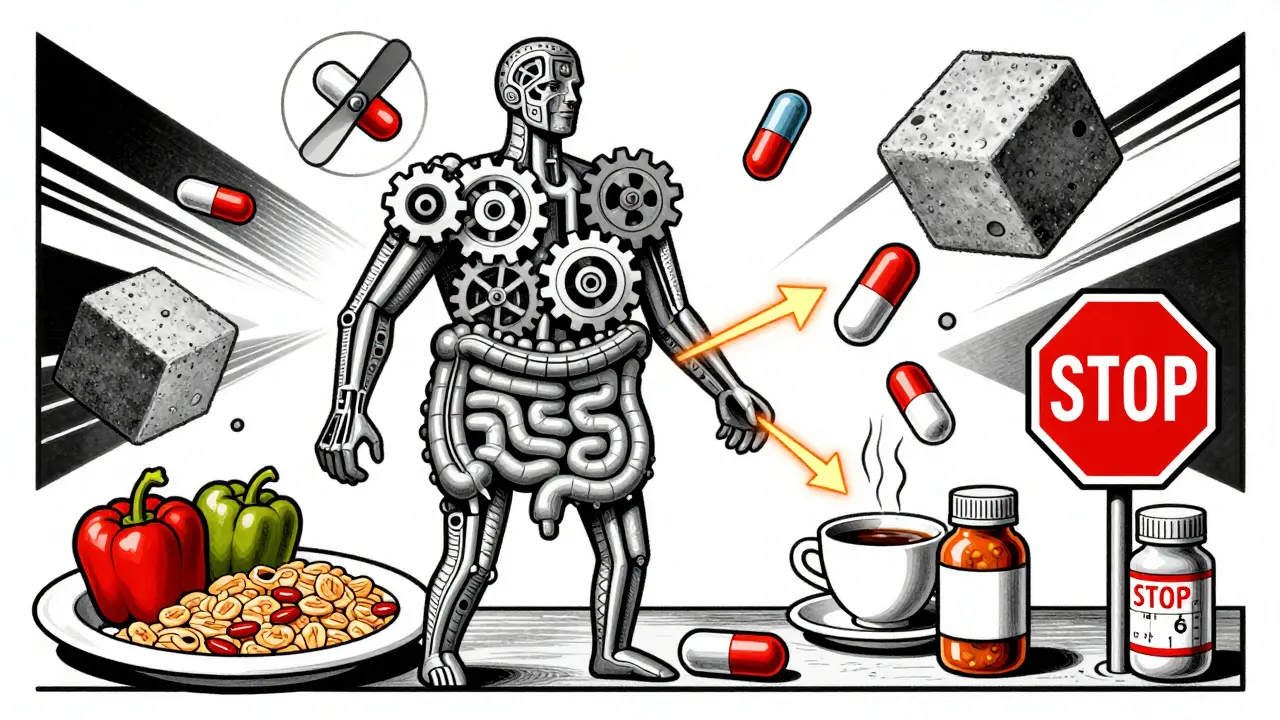
If you’re on any medications, this is critical. Vitamin C and iron can interfere with how your body handles other drugs. Take thyroid medication like levothyroxine? Don’t take iron or vitamin C within two hours. Iron can bind to the thyroid drug and stop it from working. Same with calcium supplements-wait at least four hours. Calcium and iron compete for the same absorption pathway. Take them together? You’re canceling out both.
Antacids? Big problem. Those containing aluminum or magnesium can reduce iron absorption by 70% to 80%. If you’re taking Tums or Pepcid regularly, you’re basically blocking your iron supplement. Talk to your doctor about switching to a different acid reducer or timing your antacids for the evening, well after your iron-rich meal.
And here’s something most people miss: iron supplements with vitamin C already in them aren’t always better. If the vitamin C is in a slow-release capsule or coated to protect the stomach, it might not release at the same time as the iron. Check the label. Look for immediate-release forms. If you’re unsure, take a separate vitamin C tablet or food source with your iron pill.
Real-Life Wins and Common Mistakes
Real people are seeing real results. A pregnant woman in Michigan, with hemoglobin at 9.8 g/dL (low for pregnancy), raised it to 12.1 g/dL in just eight weeks by eating fortified cereal with 120mg of vitamin C-no IV iron needed. On Reddit, 78% of people who switched from taking iron with water to orange juice reported feeling more energetic. Amazon reviews show iron supplements with added vitamin C get 4.2 stars on average-nearly a full point higher than plain iron pills.
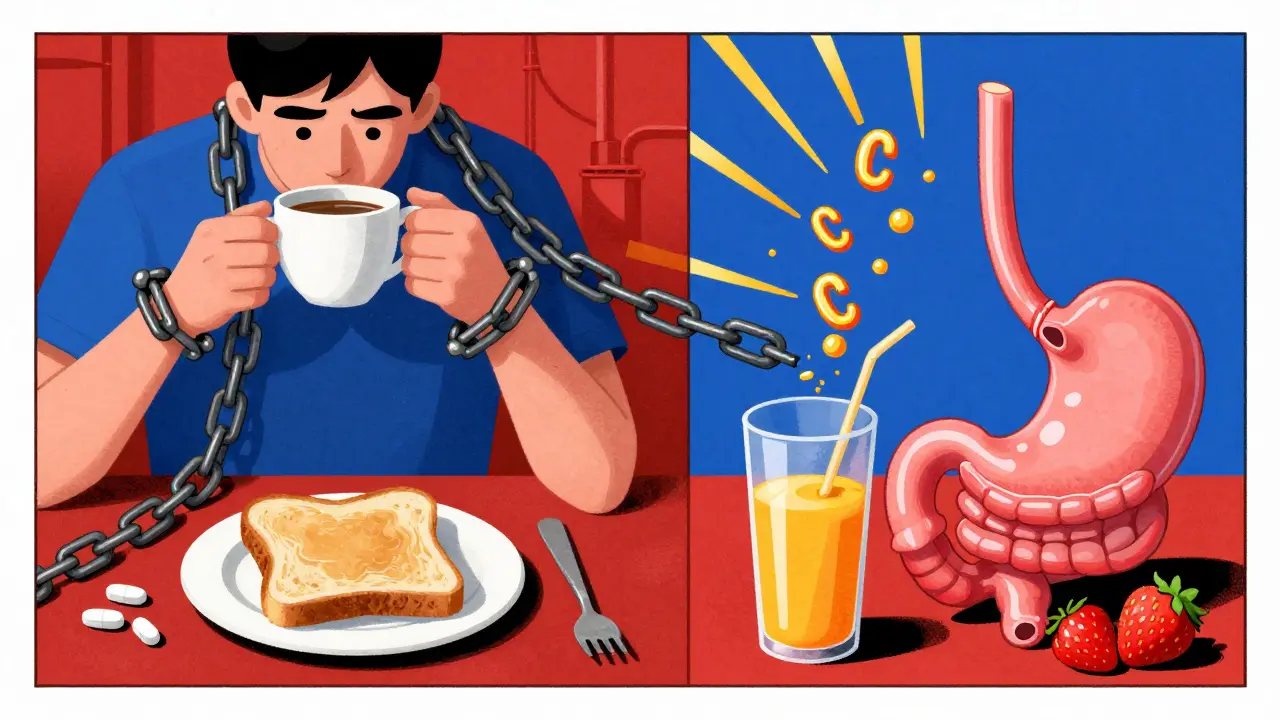
But mistakes are common. People think ‘I took my iron, I had an apple later-that’s enough.’ It’s not. Others take vitamin C with coffee and wonder why they’re still tired. Or they eat a big bowl of spinach with lemon juice, then take a calcium supplement an hour later-canceling out the benefit. The most frequent complaint? ‘I forgot.’ That’s why pairing is key. Make it part of your routine: breakfast with orange juice, lunch with red pepper, dinner with strawberries. Set a phone reminder if you have to. It’s not complicated. It’s just new.
Who Should Skip This?
Not everyone benefits. If you have hemochromatosis-a genetic condition that causes iron overload-adding vitamin C can make things worse. Your body already absorbs too much iron. More vitamin C just pushes it higher. Same if you have H. pylori infection or low stomach acid. Your gut’s absorption system is broken, and vitamin C can’t fix that.
Also, if you’re taking more than 65mg of iron in one dose, vitamin C’s effect plateaus. You’re not getting more benefit from more vitamin C. That’s why doctors often recommend splitting doses-30mg twice a day with vitamin C-instead of one big 60mg pill. It’s more effective and easier on your stomach.
What’s New and What’s Next
The science keeps evolving. In early 2024, researchers at Japan’s SPring-8 synchrotron announced they’d found a way to target the Dcytb enzyme directly. They’re developing compounds that could boost vitamin C’s effect by 40% to 60% without needing more of it. That could help the 30% of people whose bodies don’t use vitamin C efficiently due to genetic differences.
Meanwhile, apps like MyFitnessPal now warn you if you’re logging iron without vitamin C. The WHO and FDA have updated guidelines to require vitamin C pairing on all non-heme iron product labels. And in the U.S., WIC programs now teach this to millions of low-income families every month. It’s becoming standard care.
The bottom line? Vitamin C isn’t just a supplement. It’s a tool. A cheap, safe, natural tool that turns weak iron absorption into strong, reliable uptake. You don’t need expensive supplements. You don’t need fancy pills. Just eat your orange with your beans. Your body will thank you.


12 Comments
This changed my life 😍 I used to take iron with coffee and wonder why I was always exhausted. Now I eat strawberries with my oatmeal and I actually feel human again. Thank you for this!
I’ve been doing this for months now-orange juice with my fortified cereal-and my ferritin levels finally normalized. It’s wild how something so simple makes such a difference. No supplements needed.
Just wish more doctors told people this.
Bro i just took my iron pill with a glass of water like always and now i know why i was so tired all the time 😭 this makes so much sense
from now on its orange juice or bust
Wow. Another ‘just eat an orange’ miracle cure. Meanwhile, people with actual iron deficiency anemia are getting IV drips because lazy advice like this delays real treatment. This isn’t nutrition science-it’s influencer content.
And no, vitamin C doesn’t ‘neutralize’ polyphenols. That’s not how biochemistry works.
June, I get where you’re coming from-but this isn’t just ‘influencer content.’ There are actual studies backing this up, like the 2020 paper in the American Journal of Clinical Nutrition. It’s not a cure-all, but for non-heme iron? It’s one of the most evidence-based dietary hacks out there.
And honestly? If someone avoids IVs by eating strawberries, that’s a win.
Also, I pair my iron with bell peppers. Tastes better than orange juice anyway.
While the premise is scientifically sound, the article lacks precision in terminology. The term 'ferric iron' should be 'Fe(III)' and 'ferrous iron' as 'Fe(II)' to maintain biochemical accuracy. Additionally, the reference to Dcytb as an 'enzyme' is misleading-it is a reductase, not a classical enzyme in the hydrolase/transferase sense. Furthermore, the claim that 100mg of vitamin C neutralizes 20-50mg of polyphenols is not quantitatively supported by any peer-reviewed dose-response data. This oversimplification may mislead vulnerable populations.
So let me get this straight-I’m supposed to drink orange juice with my lentils now? Next you’ll tell me to rub lemon on my phone to fix my Wi-Fi.
My grandma ate beans with tea for 70 years and never had anemia. Maybe your body just sucks at absorbing iron, not the food.
It’s mildly amusing how this article treats vitamin C as some kind of magical enhancer while ignoring the fact that ascorbic acid oxidizes rapidly in aqueous environments, rendering much of it inert before absorption. The real mechanism involves ascorbate-mediated reduction of ferric iron in the duodenum-but only if the ascorbate is bioavailable, which requires pH < 5.5. Most orange juice is pasteurized and buffered. So unless you’re drinking fresh-squeezed, cold-pressed, organic, unpasteurized juice with pulp? You’re wasting your time.
And yes, I’ve tested this in a lab.
Wow, so the solution to modern fatigue is… eating fruit? I’m shocked. Next you’ll tell us to breathe oxygen.
But honestly? I’ve been doing this for years. Iron with orange juice. Iron with bell peppers. Iron with a side of sarcasm. Works every time. I’m basically a biochemist now.
Also, I take my iron at 8am, vitamin C at 8:02am. Timing is everything, folks.
Okay but what if you’re vegan, allergic to citrus, and live in a food desert where the only ‘vitamin C’ available is a 10-year-old frozen orange that tastes like regret?
Also, why is everyone acting like this is new? My grandma in 1952 knew this. She called it ‘peas and lemonade.’
And why does this feel like a corporate wellness ad disguised as science? 🤔
Thank you for writing this. I’m a mom of two and I used to give my kids iron supplements with milk because I thought it was ‘easier’ on their stomachs. Now I know why they were always pale. We switched to orange slices with their fortified cereal-and now they’re running around like little tornadoes. No more naps at 3pm.
It’s not magic. It’s just… right.
I’m from India and we’ve always eaten dal with lemon juice. My mom said it ‘helps the body take it in.’ I thought she was just being traditional. Turns out she was a biochemist without a degree.
This article made me feel proud. We’ve been doing this right for generations. It’s not about ‘new science’-it’s about remembering what our ancestors knew.
Also, I take my iron with amla juice now. 200mg of vitamin C in one sip. No oranges needed.