

Returning to work with chronic pain isn’t about pushing through the discomfort. It’s about creating a plan that lets you work without making your pain worse. If you’ve been on leave because your back, joints, or nerves won’t let you sit, stand, or move like you used to, you’re not alone. Over 50 million adults in the U.S. live with chronic pain - and many of them want to keep working. The good news? Most accommodations cost little or nothing. The key is knowing what to ask for - and how to ask for it.
What Counts as a Legal Accommodation?
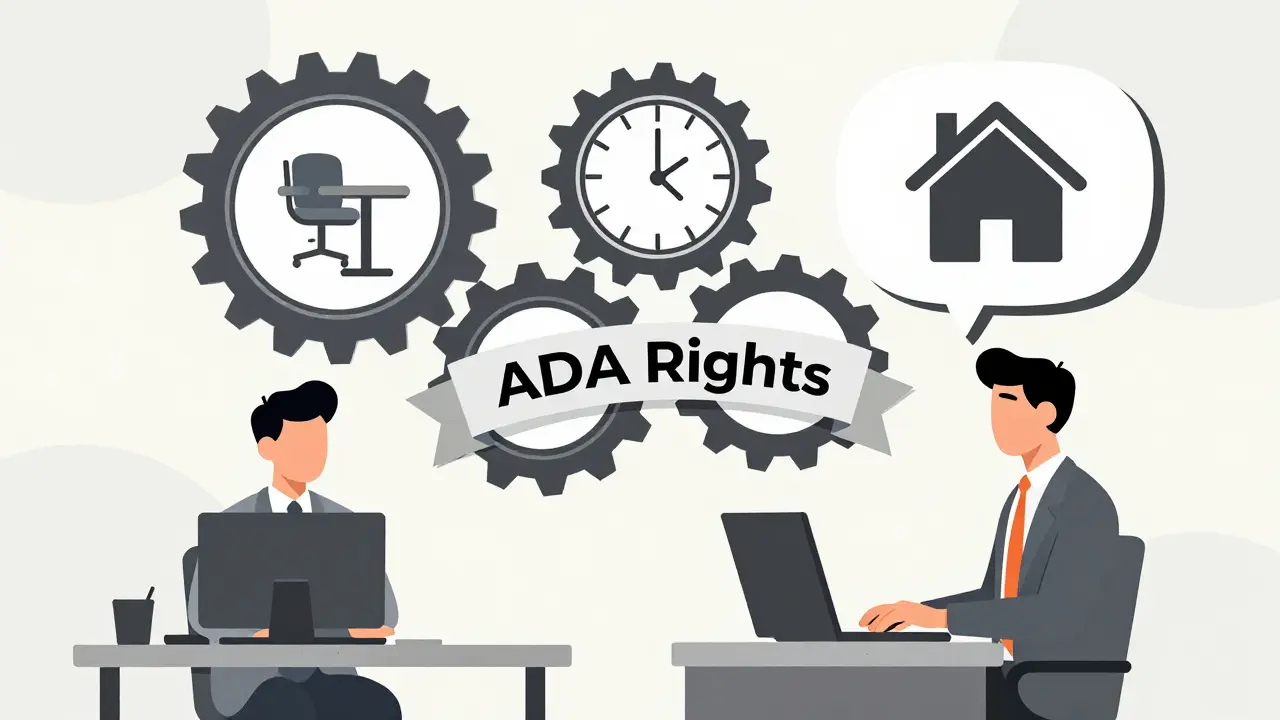
Under the Americans with Disabilities Act (ADA), chronic pain that limits major life activities - like walking, sitting, lifting, or concentrating - is protected. That means if your pain makes it hard to do your job, your employer must make reasonable changes to help you keep working, unless it causes them serious difficulty or expense. This isn’t a favor. It’s the law.But here’s the catch: the ADA only applies to employers with 15 or more workers. If you’re at a smaller company, check your state laws. In California, for example, employers with just five employees must provide accommodations. Federal workers are covered under the Rehabilitation Act, which has even stronger protections.
Accommodations aren’t one-size-fits-all. They’re tailored to your job and your pain. A warehouse worker with spinal stenosis might need a stool to sit while packing. An office worker with fibromyalgia might need a standing desk and extra breaks. Both are valid. What matters is how your pain affects your ability to do your actual tasks - not how it looks to someone else.
Common Accommodations That Actually Work
Most employers think accommodations mean big, expensive changes. They don’t. According to the Job Accommodation Network, 56% of accommodations for chronic pain cost nothing at all. Here’s what actually gets done:
- Ergonomic chairs and standing desks: A good chair costs $200-$1,000. A standing desk runs $300-$1,200. But many employers already have spare equipment. Ask if they can swap out your chair or let you use a standing desk temporarily.
- Flexible hours and breaks: Need to leave at 3 p.m. for physical therapy? Need a 10-minute break every 90 minutes to stretch? These are simple, low-cost fixes. Studies show employees who get regular breaks report 30% less pain flare-ups.
- Working from home: If commuting or being in a noisy office makes your pain worse, telecommuting - even part-time - can make a huge difference. You don’t need to be full-time remote. Two days a week can be enough to reset your body.
- Modified duties: Can you swap out heavy lifting for data entry? Can you handle phone calls instead of standing at a counter? Job duties can be adjusted as long as the core functions remain. Marginal tasks? Those can be reassigned.
- Assistive tools: Voice recognition software ($100-$300), footrests ($25-$150), heated cushions ($50-$200), or even a simple gel pad for your keyboard can reduce strain. These aren’t luxuries - they’re tools, like glasses for vision.
- Environmental tweaks: If cold or heat makes your pain worse, ask for a space heater, fan, or relocation to a room with better climate control. For people with multiple sclerosis, even a 5°F change can make work possible or impossible.
One nurse in Sydney switched from standing all day to sitting with a footrest and a cushioned mat. Her pain dropped from an 8/10 to a 3/10 within two weeks. She didn’t need surgery. She just needed a different setup.
How to Ask for Accommodations - Without Getting Pushed Back
Here’s the hardest part: asking. Sixty-two percent of people with chronic pain delay asking for help because they fear being seen as weak, lazy, or unreliable. But silence doesn’t protect you - it hurts you more.
Don’t say: “I’m in a lot of pain. Can I work from home?”
Say this instead: “I have chronic lower back pain diagnosed by my doctor on March 12, 2025. It makes it hard to sit for more than 45 minutes without increased pain and numbness. I’d like to request a sit-stand desk and 10-minute stretch breaks every 90 minutes to help me stay productive. My doctor’s note is attached.”
Specificity wins. Vague requests get denied. Clear, documented ones get approved. The EEOC says 55% of accommodation denials happen because the request was too general. If you say “I need pain relief,” they don’t know what you mean. If you say “I need a heated seat cushion that plugs into a standard outlet,” they can find one.
Always put your request in writing. Email is fine. Keep a copy. Mention the ADA. Say you’re asking for a reasonable accommodation under federal law. Don’t apologize. You’re not asking for a special treat. You’re asking for the right to work.
The Interactive Process - What Happens Next
Once you ask, your employer must start the “interactive process.” That means they have to talk to you. They can’t just say no. They can suggest alternatives, but they can’t force you to take one you don’t think will work. You get a say.
Here’s how it usually goes:
- You submit a written request with medical documentation.
- Your employer responds within 10-15 business days (federal agencies) or “promptly” (private sector).
- You meet to discuss options - HR, your manager, maybe an occupational therapist.
- You try the accommodation. It doesn’t have to be perfect right away.
- You adjust. If it doesn’t help, you go back and try something else.
Many employers don’t know how to do this. That’s why the Job Accommodation Network (JAN) exists - and it’s free. You can call them or visit their website. They’ll help you draft your request, explain your rights, and even talk to your employer if needed. They resolve 82% of cases without legal action.
What If They Say No?
They can say no - but only if they prove it’s an “undue hardship.” That means the cost or difficulty is too high for their business size. A small shop with 8 employees might not afford a $1,000 desk. A corporation with 10,000 employees? That’s not a hardship.
If you’re denied:
- Ask for the reason in writing.
- Check if they offered any alternatives.
- Call JAN for help - they’ll review your case for free.
- If you’re in California or another state with stricter laws, you may have more leverage.
- Document everything. Dates, emails, meetings.
Don’t quit yet. Many denials are overturned after someone from JAN steps in. And if your pain is getting worse, you may qualify for short-term disability or FMLA leave while you work out a better plan.
Gradual Return - Don’t Jump Back In
Trying to go back full-time after months off often backfires. You end up in more pain, take more time off, and feel defeated.
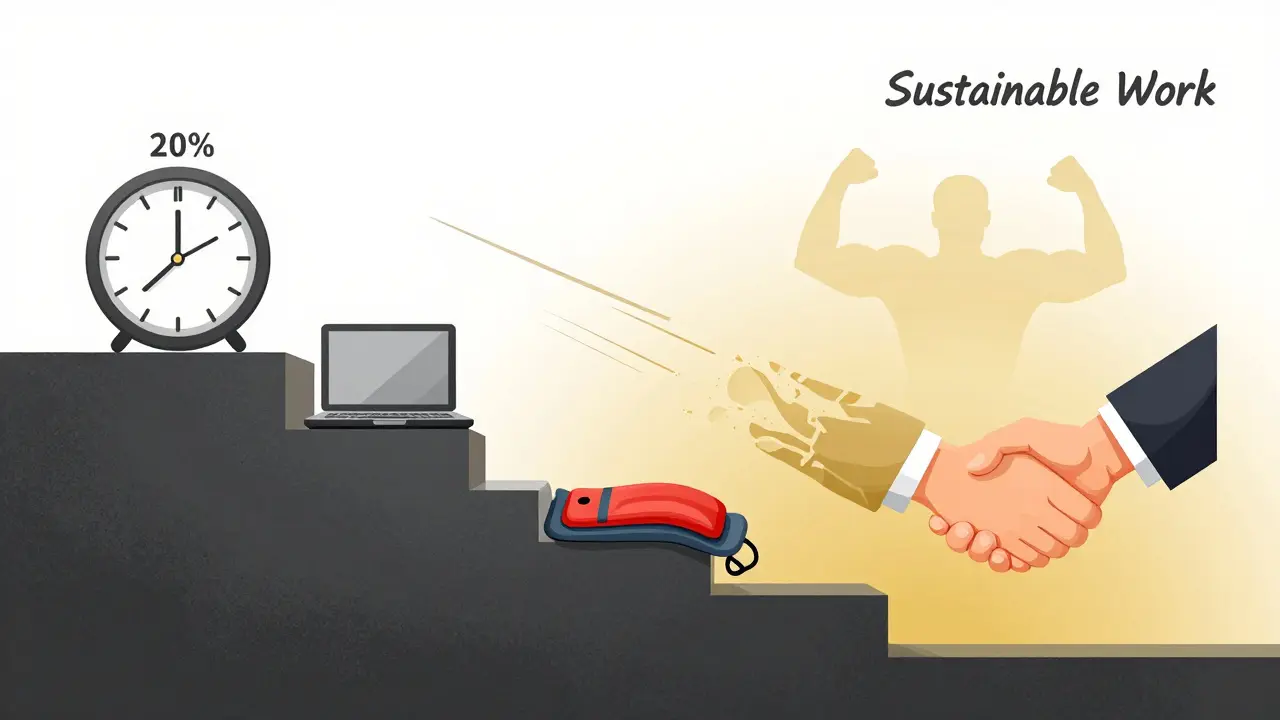
A better approach: graduated return to work. Start with 20-50% of your normal hours. Work three days a week. Come in for just four hours. Use your accommodations from day one. Slowly add time as your body adjusts.
Research shows this method increases long-term retention by 63% compared to jumping straight back to full-time. You’re not slacking - you’re being smart. Your body needs time to rebuild stamina, just like after an injury.
Why Coworkers and Supervisors Matter
Accommodations aren’t just about desks and software. They’re about culture.
Studies show employees with strong relationships with their team are 2.3 times more likely to get their accommodations approved. Why? Because when coworkers understand your situation, they help. They cover for you during breaks. They don’t assume you’re slacking when you’re sitting down. They speak up when managers push back.
Supervisors matter even more. If your boss thinks chronic pain is “all in your head,” you’ll struggle. But if they’ve seen someone else succeed with the same accommodation? They’ll be your biggest ally.
Consider sharing a short, simple explanation: “I have a nerve condition that flares up. I’m not sick - I just need a few adjustments to keep working. I’m not asking for special treatment. I’m asking for a fair chance.”
What to Do If You Can’t Return
Not everyone can return to work. Some pain is too severe. Some jobs are too physically demanding. That doesn’t mean you’ve failed.
If you’ve tried accommodations and still can’t function, explore other options:
- Apply for Social Security Disability Insurance (SSDI) if you’ve paid into it.
- Look into vocational rehabilitation programs - they help people retrain for new jobs.
- Consider part-time, remote, or freelance work that fits your energy levels.
Leaving a job doesn’t mean giving up. It means choosing your health. And sometimes, that’s the bravest thing you can do.
Final Tips: What to Bring to Your Meeting
When you meet with HR or your manager, come prepared:
- A written request (drafted in advance).
- A doctor’s note that lists your diagnosis and functional limits - not just “pain.”
- Specific accommodation ideas (e.g., “I need a footrest and a 10-minute break every 90 minutes”).
- A list of alternatives if your first choice isn’t possible.
- A copy of the JAN website or a printout of their free resources.
Bring confidence. You’re not asking for charity. You’re asking for the right to work. And under the law, you already have it.
Can my employer fire me for having chronic pain?
No. If your chronic pain qualifies as a disability under the ADA or similar laws, firing you because of it is illegal. Employers must provide reasonable accommodations unless doing so causes undue hardship. If you’re fired after requesting an accommodation, you may have a discrimination claim.
Do I need a doctor’s note to get accommodations?
Yes. Your employer can legally ask for documentation from your healthcare provider that confirms your diagnosis and explains how your pain limits your ability to perform job tasks. The note doesn’t need to say exactly what accommodation you want - just what you can and can’t do physically.
What if my job doesn’t have a human resources department?
Talk directly to your manager or owner. Send your request in writing via email. Even small businesses with fewer than 15 employees may still be required to accommodate you under state law. If they refuse, contact the Job Accommodation Network (JAN) - they can guide you on your next steps.
Can I ask for accommodations even if I haven’t taken leave yet?
Absolutely. You don’t need to be on leave to request accommodations. If your pain is affecting your performance or making work harder than it should be, you can ask for help before you hit a crisis. Early requests often lead to smoother outcomes.
Are accommodations permanent?
Not necessarily. Some accommodations are temporary - like a cushion during a flare-up. Others are long-term, like a standing desk for someone with degenerative disc disease. Your needs may change, and that’s okay. You can ask to adjust your accommodations anytime. The goal is to keep you working, not to lock you into one setup forever.








8 Comments
Yeah sure, let’s just assume every guy with back pain isn’t just trying to get out of work. I’ve seen people on disability ride motorcycles on weekends but can’t sit in an office chair for 8 hours. This article reads like a manual for freeloaders.
This is pure socialist propaganda dressed up as ‘reasonable accommodation.’ The ADA was never meant to turn workplaces into therapy centers. Next they’ll be demanding heated desks for people who ‘feel cold’ or nap pods for ‘mental fatigue.’ Where does it end? When the government pays your boss to babysit you? I’m tired of this entitlement culture.
While the intent of the article is commendable, I must emphasize that the legal framework surrounding workplace accommodations is not merely a matter of individual preference or comfort, but a complex interplay of statutory obligations under Title I of the ADA, the Rehabilitation Act of 1973, and state-specific labor codes, which vary significantly in scope and enforcement mechanisms. Employers are required to engage in a good-faith interactive process, but the definition of ‘undue hardship’ remains subject to judicial interpretation, often contingent upon factors such as organizational size, financial resources, and operational structure. Moreover, the efficacy of accommodations such as sit-stand desks or flexible scheduling must be evaluated not only in terms of pain reduction but also in alignment with essential job functions, productivity metrics, and workplace equity. Documentation from licensed healthcare providers must be clinically specific and functionally oriented, not merely anecdotal. Failure to adhere to these procedural and evidentiary standards may result in non-compliance, even with the best intentions.
My cousin got a footrest and a 10-minute break every 90 minutes after her fibro flared up. She’s been working full-time for two years now. No drama. No fuss. Just a small change that made all the difference.
Ugh, another one of these ‘you deserve a heated cushion’ articles. Look, if you can’t handle a regular chair, maybe you shouldn’t be in an office. I’ve had chronic pain for 15 years and I still show up. You don’t get a trophy for being weak.
This is one of the most practical, compassionate, and legally grounded guides I’ve read on this topic. The emphasis on specificity - not just ‘I’m in pain’ but ‘I need a footrest and a 10-minute stretch every 90 minutes’ - is exactly what makes accommodations work. Too many people fear asking because they think they’re being burdensome. They’re not. They’re exercising a legal right. And the gradual return to work? Brilliant. It’s not about going slow because you’re lazy - it’s about going smart because your body needs time to adapt. If you’re reading this and you’re struggling, please reach out to JAN. They’ve helped thousands. You’re not alone.
As someone who’s worked in HR across three countries, I’ve seen this play out in real time. In the U.S., the ADA is clear - but in practice, managers often don’t know how to respond. In India, where I worked for a while, the approach was more community-based - coworkers would naturally adjust schedules or help with tasks without formal requests. It’s not about the law alone. It’s about culture. And this article? It helps build that culture - one specific, respectful request at a time.
Just wanted to say thank you for writing this. I’ve been holding off on asking for a standing desk because I thought I’d be seen as ‘needy.’ Now I’m going to send my manager the exact template from the article. 💪